
Online travel agencies sit in one of the toughest corners of ecommerce: high ticket sizes, long fulfillment windows, frequent itinerary changes, intense fraud pressure, and a constant chargeback risk when customers are stressed, delayed, or confused about who actually charged them.
If your OTA is the merchant of record, payment security is not just “checkout encryption”—it’s a full lifecycle discipline that spans identity, authorization strategy, data protection, dispute readiness, supplier settlement, refunds, and compliance.
Secure payment processing for online travel agencies also has a unique brand challenge: travelers want speed and simplicity, but banks and card networks want friction when risk is elevated.
The best OTAs solve this with intelligent orchestration—adding verification only when needed and capturing evidence automatically in the background. They also design for operational reality: partial refunds, cancellations, reissues, ancillary add-ons, and delayed captures.
This guide explains how secure payment processing works for online travel agencies, what controls actually reduce fraud and disputes, how to align with major standards (like PCI DSS), and how to build a payments stack that can scale.
It’s written from a practical merchant perspective, using industry terminology you’ll encounter in underwriting, gateway integrations, and risk tools.
Why Travel Payments Are “High-Risk” by Design (and How to Turn That Into an Advantage)

Secure payment processing for online travel agencies starts with understanding why banks treat travel differently. Travel has a long “time-to-service” gap—your customer pays today, but the flight, hotel stay, or tour may occur weeks later.
That gap creates more opportunity for disputes (“services not received”) and more exposure if suppliers fail. Card-not-present (CNP) risk is also structurally higher because most bookings happen online and many transactions originate from mobile devices, where identity signals can be weaker.
Travel also produces complex payment events: split bookings, itinerary changes, partial cancellations, add-ons (bags, seats, insurance), and multi-supplier packages.
Each event is a chance for billing confusion. Confusion is a major driver of “friendly fraud,” where the customer disputes a legitimate charge because the descriptor looks unfamiliar, or because they tried a refund path that felt slow.
The good news is that these realities allow you to build strong risk differentiation. OTAs have rich context that typical ecommerce merchants don’t: passenger name records, itinerary data, IP-to-origin consistency, device fingerprints across sessions, repeat traveler patterns, loyalty identifiers, and behavioral signals around search and booking.
When you structure secure payment processing for online travel agencies around these signals, you can approve more good customers while surgically challenging risky ones.
An advantage-focused approach means you don’t just “block fraud.” You design secure payment processing to reduce false declines, improve authorization rates, and prevent revenue leakage from disputes.
The goal is to make your OTA a low-risk merchant in a high-risk category—something acquirers and processors reward with better stability, fewer reserves, and more scalable volume growth.
Core Architecture of Secure Payment Processing for Online Travel Agencies
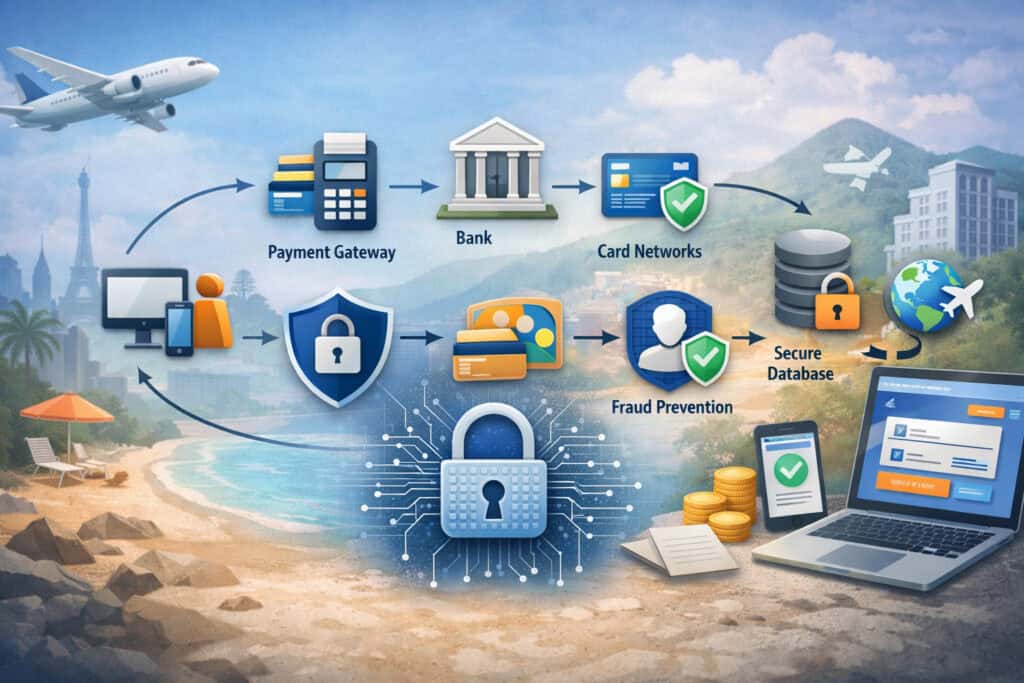
A modern OTA payment stack usually consists of four layers: checkout experience, payment gateway/orchestration, processor/acquirer, and risk/disputes tooling. Secure payment processing for online travel agencies depends on how cleanly these layers share signals and how well they map to travel use cases.
At checkout, your UI captures the minimum needed data while still supporting verification flows (3DS challenge, step-up authentication, address verification, and device verification). The orchestration layer then decides routing, fraud checks, and whether to apply step-up flows.
It also standardizes tokenization so your application never stores raw card numbers. Your processor/acquirer handles authorization, settlement, and network rules compliance. Risk and disputes tooling (fraud engines, chargeback platforms, analytics, and case management) provides prevention and evidence packaging.
The biggest architectural mistakes OTAs make are (1) treating fraud, payments, and disputes as separate silos and (2) implementing security controls that break travel-specific workflows (like incremental authorizations, delayed capture, or multiple partial refunds).
Secure payment processing for online travel agencies should be event-driven: every booking status change should automatically trigger the right payment action and evidence capture.
For example, if a flight is rescheduled, your system should log supplier confirmation, customer acknowledgment, and reissued ticket details—then store those artifacts in a dispute-ready format.
Finally, architecture must support multi-currency, multi-entity, and multi-supplier settlement without exposing sensitive data.
If you pay suppliers via virtual cards, bank transfers, or alternative rails, your platform should enforce consistent controls: beneficiary verification, sanctions screening where applicable, reconciliation, and audit logs. Security isn’t only about card data—it’s about preventing payout fraud, supplier impersonation, and refund abuse.
PCI DSS, Data Protection, and What “Secure” Actually Means in 2026

If you accept card payments, PCI DSS is the baseline security standard for protecting payment card data. The PCI Security Standards Council has published PCI DSS v4.0.1 and supporting materials, reflecting the current generation of the standard.
Secure payment processing for online travel agencies typically aims to minimize PCI scope by using hosted fields, tokenization, and not storing primary account numbers (PANs) in your environment.
A key 2026 reality is that “secure” no longer means only firewalls and encryption. PCI DSS v4 introduced new emphasis areas like targeted risk analysis, stronger authentication, and more continuous controls.
Many previously “best practice” items became mandatory after the transition window described by industry guidance around the March 31, 2025 milestone for v4 requirements becoming required.
Practically, that means OTAs should build security as a system, not a checklist: continuous vulnerability management, secure coding practices, access control hygiene, logging/monitoring, and incident response readiness.
For OTAs, a secure payment posture usually includes:
- Tokenization everywhere: tokens in your database, tokens in customer profiles, tokens in recurring or stored payment methods.
- Encryption in transit and at rest: not only for payment data, but for itinerary and identity data that could be used for account takeover.
- Least privilege + MFA: especially for admin portals, refund tools, supplier settlement systems, and customer support consoles.
- Segmentation: isolate card-handling components, restrict network paths, and reduce lateral movement risk.
- Vendor governance: gateways, fraud tools, CRM, analytics, and call center platforms must be assessed for data handling and access.
Security also includes customer support workflows. A surprising number of breaches and losses come from social engineering: fraudsters calling support to change emails, reroute confirmations, or request refunds to new destinations.
Secure payment processing for online travel agencies must include support-side controls like step-up verification for sensitive account changes, refund destination locking rules, and strong audit trails.
Travel-Specific Fraud Threats and How to Stop Them Without Killing Conversion

Fraud in travel is rarely a single pattern. It’s a portfolio: card testing, stolen cards used for high-value bookings, account takeover (ATO) of legitimate traveler accounts, triangulation schemes, and refund abuse.
Secure payment processing for online travel agencies requires you to treat fraud prevention as a funnel—screening earlier in the journey, not only at payment.
A practical travel fraud model uses layered controls:
- Pre-checkout controls: bot mitigation, rate limiting, and velocity checks on search/booking attempts.
- Identity and device signals: device fingerprinting, IP reputation, behavioral biometrics, and account age/trust.
- Payment verification: AVS/CVV, BIN intelligence, issuer country vs itinerary consistency, and 3DS where justified.
- Post-authorization monitoring: watchlist matches, high-risk itinerary combinations, and risky supplier or route patterns.
- Fulfillment controls: additional checks before ticketing, voucher issuance, or sending confirmation.
The key is avoiding “security theater.” If you apply friction to everyone, you’ll lose bookings and still miss sophisticated fraud. Instead, focus on risk-based step-ups.
For example, a returning customer booking a domestic flight on a known device should see a one-click checkout. A brand-new account booking a premium multi-leg itinerary with mismatched IP and billing signals should be stepped-up with 3DS challenge or alternative verification.
Refund abuse is especially important in travel. Fraudsters may book refundable rates, trigger refunds, or claim cancellations with forged evidence.
Secure payment processing for online travel agencies should enforce refund policy rules at the system level: refundable vs non-refundable mapping, time windows, supplier policy ingestion, and validation that refund destinations match original funding sources when required.
Real-world example: an OTA selling flights and hotels might see ATO where attackers log into a real customer’s account, book a refundable hotel, then cancel and reroute the refund via support.
A secure design blocks “refund destination changes” without strong verification, and it flags cancellations shortly after booking that occur from a new device, new IP, or unusual geolocation pattern.
Strong Customer Authentication, 3DS, and Travel Checkout Design That Works
3D Secure (3DS) can dramatically reduce certain dispute types by shifting liability in qualifying cases, but it can also reduce conversion if used bluntly. Secure payment processing for online travel agencies should implement 3DS as a policy engine—triggered by risk, not as a universal requirement.
In practice, you want:
- Frictionless 3DS for low-risk transactions where the issuer approves without challenge.
- Challenge flows for higher-risk transactions where the issuer wants step-up.
- Exemptions and routing were supported, balanced against fraud exposure.
Travel checkout is also sensitive to mobile UX. If your 3DS flow breaks deep links, fails on certain browsers, or doesn’t preserve session state, you’ll see drop-offs.
That’s why many OTAs treat payment as an orchestrated experience: the gateway and 3DS server should support modern SDK flows, robust redirect handling, and clear user messaging about why verification is needed (“Protecting your booking from fraud” rather than vague “authentication required”).
Secure payment processing for online travel agencies also benefits from “descriptor clarity” and confirmation consistency. Travelers often dispute when they don’t recognize the charge name or see multiple supplier confirmations.
Use a recognizable statement descriptor, include itinerary references in receipts, and ensure your confirmation emails match what is shown at checkout. The fewer surprises, the fewer disputes.
A business example: an OTA selling tours and activities may apply 3DS only when the booking occurs within 48 hours of the event (high urgency), when the customer is new, or when device/IP signals show anomalies.
For established customers with stored tokens and a consistent device, the OTA skips 3DS to preserve conversion while still maintaining strong protection through account trust scoring.
Authorization Strategy: Preventing Declines While Staying Secure
Travel payments fail for reasons beyond fraud. Issuers decline for insufficient funds, incorrect data entry, risk flags, or inconsistent metadata. Secure payment processing for online travel agencies should include a deliberate authorization strategy that improves approval rates without increasing fraud.
Key tactics include:
- Clean data and consistent fields: standardized address formats, accurate billing zip, and correct currency handling.
- Smart retries: retry only when it’s likely to help (soft declines), and avoid repeated attempts that look like card testing.
- Network tokenization: where available, network tokens can improve approval and reduce fraud because credentials are more trusted and automatically updated.
- Adaptive routing: route to the best-performing acquirer or processor for certain BIN ranges or regions, if your volume justifies it.
Delayed capture is a travel reality, especially if you confirm availability first and ticket later. But delayed capture can increase disputes if customers don’t see fulfillment. Make your timeline clear: “You’ll see a pending authorization now, and the final charge when ticketing is confirmed.” Also ensure your capture timing aligns with supplier fulfillment.
Another travel-specific issue is incremental authorizations and partial captures—common in hospitality and sometimes in packages. Your processor and gateway must support these flows correctly, or you’ll end up with mismatched totals and disputes.
Secure payment processing for online travel agencies includes ensuring your payment provider can handle travel-style transaction lifecycles, not only simple “authorize + capture.”
Finally, secure does not mean “decline everything suspicious.” Over-declining creates customer frustration, increases call center costs, and can push customers to less secure channels.
Use a consistent risk framework that aims for the highest safe approval rate, and monitor false decline metrics alongside fraud and chargeback rates.
Chargebacks and Disputes: The Travel Playbook to Win More Cases
In travel, disputes are not an occasional annoyance—they’re a core operational risk. Industry reports have highlighted the scale and growth of chargebacks, including forecasts showing continued increases in volume over the coming years. Secure payment processing for online travel agencies must include dispute readiness from day one.
Two travel dispute categories dominate:
- Fraud disputes (cardholder claims they didn’t authorize)
- Service disputes (services not received, cancellations, refunds not processed, “not as described”)
Card network reason codes vary by brand and can change over time, but common reason families include “card-absent fraud” and “services not received.”
Winning disputes requires evidence that matches the reason code expectations: proof of authorization, proof of delivery/fulfillment, proof of disclosed policies, and proof of customer communication.
A strong OTA dispute program includes:
- Compelling evidence automation: store booking confirmation, IP/device data, 3DS results, customer login history, receipts, supplier confirmations, and refund timelines.
- Policy transparency: cancellation/refund terms clearly displayed at checkout and in confirmation.
- Refund discipline: process refunds within stated timelines and communicate status updates proactively.
- Descriptor management: clear descriptors and support references reduce “I don’t recognize this charge” disputes.
- Pre-dispute resolution: when possible, resolve issues before they become chargebacks via rapid support and clear self-service.
Real-world example: a customer disputes a hotel booking claiming “services not received” after a cancellation. If your records show the cancellation window was missed, your evidence should include the exact policy shown at checkout, timestamped acceptance, and the supplier’s non-refundable confirmation.
If you did issue a partial credit, include the credit receipt and posting timeline. The dispute win often comes down to documentation quality and relevance, not argument.
Secure payment processing for online travel agencies treats chargebacks as preventable revenue leakage. You measure dispute rate, representation win rate, “friendly fraud” indicators, and operational root causes (refund delays, itinerary confusion, supplier failures) and then fix the upstream issues.
Refunds, Cancellations, and Chargeback-Proof Customer Experience
Refund experience is a security strategy. When travelers can’t find policy details, can’t reach support, or don’t trust the process, they escalate to bank disputes. Secure payment processing for online travel agencies includes designing a refund system that is fast, transparent, and aligned with supplier rules.
A travel-ready refunds engine should support:
- Partial refunds (one leg canceled, one traveler removed, one night shortened)
- Credits and vouchers (where applicable and clearly disclosed)
- Supplier-backed refunds vs OTA-funded refunds (and clear communication about which applies)
- Refund status tracking (requested → approved → submitted → posted)
- Proof logging (customer requests, approvals, and policy acceptance)
A common failure is letting refunds become manual exceptions. Manual workflows create delays and errors—and errors create disputes. Instead, treat refunds as structured payment events with strict rules and audit trails.
For instance, if your OTA offers “cancel for credit,” that option must be shown clearly at purchase and again at cancellation, with explicit acknowledgment to reduce later “misrepresentation” claims.
Secure payment processing for online travel agencies also means managing traveler expectations when suppliers are slow.
A card refund may take several business days to post; the right approach is proactive messaging: “Approved today; your bank may take X days.” Combine that with immediate confirmation and a refund reference number.
Operational example: an OTA selling activities can drastically reduce disputes by enabling “instant self-cancel” within policy and issuing immediate confirmation of refund eligibility—even before funds are posted. That reduces anxiety, which reduces disputes.
Regulatory and Legal Realities OTAs Can’t Ignore
Travel is regulated through a mix of federal oversight (for certain segments) and state-level consumer protection frameworks.
Secure payment processing for online travel agencies must also account for who you are in the transaction: intermediary, agent, or merchant of record. That status affects liability, refund responsibility, and disclosure duties.
Many OTAs and agencies need to be aware of Seller of Travel (SOT) laws in certain states, which can require registration and sometimes bonding or other consumer protection measures.
While the exact requirements vary by state, the important operational takeaway is that your payment flows and disclosures must match your legal posture. If you are collecting funds and issuing your own confirmations, regulators may treat you differently than a pure referral model.
On the financial compliance side, OTAs should be familiar with:
- AML / KYC expectations where applicable (especially if you handle payouts, marketplace settlement, or stored value)
- Sanctions compliance considerations for certain destinations, suppliers, or parties (screening may be appropriate depending on model)
- Consumer protection rules around advertising, fees, and refund terms
Even when you outsource processing to a PSP, you retain accountability for customer experience and truthful disclosures. Secure payment processing for online travel agencies is as much about “preventing unfair billing scenarios” as it is about encryption.
Clear fees, clear refund rules, and accurate availability reduce disputes and reduce regulatory complaint exposure.
A practical compliance habit: keep a “policy evidence trail.” Store exactly what the customer saw—fees, cancellation terms, inclusions/exclusions—at the moment of purchase. That single discipline supports compliance, disputes, and customer satisfaction.
Payment Orchestration, Multi-Provider Setups, and Resilience Against Outages
Many growing OTAs move from a single processor to an orchestrated setup: multiple PSPs or acquirers, smart routing, and fallback logic. Secure payment processing for online travel agencies benefits because you indications.
Secure orchestration delivers:
- Higher uptime: if one provider has an incident, route to another.
- Better approval rates: choose the best acquirer path for specific BINs or transaction types.
- Risk segmentation: route high-risk traffic through stricter controls or specialized providers.
- Cost control: optimize interchange and processing fees with routing decisions.
However, orchestration increases complexity and can introduce security gaps if tokenization isn’t unified. The safest approach is a central token vault or a gateway that supports multi-processor token portability without exposing PAN data to your app. Ensure consistent logging, consistent dispute evidence capture, and consistent fraud rules across routes.
Resilience also includes non-card rails. If your OTA supports bank transfers, real-time payments, or digital wallets, you need clear refund policies and reconciliation.
Wallet payments can reduce certain fraud types but can introduce account takeover risk if wallets are compromised. Your risk engine should treat “wallet + new account + high-value + urgent travel” differently than “wallet + returning customer.”
A real-world resilience scenario: during a peak season promo, a gateway outage can cost massive revenue in minutes. A secure orchestrated design can fail over automatically while preserving anti-fraud protections—meaning you don’t disable risk checks just to keep payments flowing. Security and resilience must be engineered together.
Building Trust: Transparency, UX, and Support Controls That Reduce Fraud
“Trust” is an anti-fraud control. When customers trust your brand, they are more likely to contact you first rather than filing a dispute, and less likely to misinterpret descriptors or policies. Secure payment processing for online travel agencies includes trust-building elements that also improve risk outcomes.
Key trust levers include:
- Clear merchant identity: consistent brand name, descriptor, and receipts.
- Immediate confirmation: send confirmations promptly with itinerary details and support access.
- Self-service management: empower customers to view, modify, and cancel within policy.
- Proactive disruption messaging: communicate delays or supplier issues quickly.
- Support-side verification: protect account changes and refunds with step-up checks.
OTAs should also secure their “human layer.” Fraudsters often exploit support agents with urgency and social engineering. A secure support policy includes scripts and tooling for identity verification, device/account risk indicators presented to agents, and restricted privileges for refunds and changes.
For example, an agent should see: “New device login 2 hours ago; high refund risk; require step-up verification.”
Business example: an OTA sees repeated disputes linked to customers not recognizing a supplier name. Fixing the descriptor and adding “You will see ‘BrandName Travel’ on your statement” at checkout can reduce disputes more than many technical controls. Secure payment processing for online travel agencies is often about removing ambiguity.
Future Predictions: What Secure Travel Payments Will Look Like in the Next 2–5 Years
The future of secure payment processing for online travel agencies will be shaped by three forces: identity modernization, network-level tokenization, and AI-driven fraud on both sides.
- Passkeys and stronger account identity: As passkeys replace passwords, ATO risk can drop—if OTAs adopt them aggressively. That will reduce refund abuse and loyalty account fraud, two major travel pain points. Expect more “account trust” scoring to drive frictionless checkout.
- Network tokenization and credential lifecycle management: Network tokens reduce exposure to credential theft and can improve approval rates through automatic updates. Over time, secure payment processing will rely less on raw PAN-based storage and more on token-based commerce.
- AI fraud and AI defense: Fraudsters will use generative AI for more convincing social engineering, fake documents, and scripted dispute narratives. OTAs will respond with AI-assisted anomaly detection, support agent copilots that flag risk, and automated evidence assembly for disputes.
- Real-time rails and instant refunds: Faster payout and refund rails can improve customer satisfaction but can also amplify payout fraud if controls are weak. Expect OTAs to implement stronger beneficiary verification and “refund velocity” limits, especially for new accounts.
- Stronger dispute automation: As chargeback volumes continue to rise in forecasts, merchants will increasingly rely on automation to manage disputes at scale. Expect more standardized data packages, faster representation cycles, and more pre-dispute resolution integrations.
For OTAs, the competitive winners will be those who treat secure payment processing for online travel agencies as a product capability—not a back-office cost. Security will directly influence conversion, retention, and unit economics.
FAQs
Q.1: What is the most important security control for an OTA: PCI compliance, 3DS, or fraud tools?
Answer: Secure payment processing for online travel agencies requires all three, but the “most important” control depends on what you’re trying to prevent.
PCI compliance is foundational for protecting card data and reducing breach risk; it’s non-negotiable if you handle cardholder data. Fraud tools reduce unauthorized transactions and account takeover. 3DS can reduce fraud disputes and sometimes shift liability, but if overused it can reduce conversion.
In practice, the highest ROI approach is layered: minimize PCI scope through tokenization and hosted fields, run a risk engine that uses travel-specific signals, and apply 3DS selectively based on risk.
If you do only one thing “well,” build a strong evidence trail and refund transparency—because travel disputes are often driven by confusion and delays, not only fraud.
Q.2: Why do chargebacks happen so often in travel compared to other ecommerce?
Answer: Travel has unique dispute drivers: long lead times, changing plans, supplier dependencies, and partial fulfillment scenarios. When customers don’t recognize descriptors or can’t quickly confirm refund status, they dispute.
Also, common reason-code families like “card-absent fraud” and “services not received” map naturally to travel’s structure.
Secure payment processing for online travel agencies reduces chargebacks by combining prevention (risk scoring, 3DS when needed) with operational excellence (fast refunds, clear policies, strong confirmations, and pre-dispute support). You can’t “fraud-tool” your way out of a broken refund process.
Q.3: Should an OTA be the merchant of record or let suppliers charge customers directly?
Answer: Merchant-of-record (MoR) gives you control over the customer experience, pricing, and refunds—but also gives you chargeback liability, compliance obligations, and higher underwriting scrutiny. Supplier-charged models reduce your direct dispute exposure but can create customer confusion and reduce consistency.
Secure payment processing for online travel agencies in MoR mode requires stronger controls: robust dispute evidence, refund orchestration, and compliance posture.
Supplier-direct models need strong transparency so indication about who is charging, and you still need controls against referral fraud and account takeover.
The right answer depends on your brand strategy and operational maturity, but whichever model you choose must be implemented consistently across checkout, receipts, and support.
Q.4: What should OTAs log to win disputes more consistently?
Answer: At minimum, log what the customer saw and accepted at purchase, plus fulfillment proof. That includes: timestamps, IP/device identifiers, account login history, booking confirmation details, supplier confirmations, cancellation and refund policy acceptance, refund actions and timelines, and communication logs.
Because networks use structured reason codes that map to specific evidence needs, your logging should be designed around those categories (fraud vs services vs refunds).
Secure payment processing for online travel agencies is fundamentally “evidence engineering”—building systems that produce dispute-ready documentation automatically.
Q.5: How can OTAs reduce false declines without increasing fraud?
Answer: Use better signals and smarter routing. Clean data at checkout, avoid excessive retries, and use a risk engine that distinguishes new high-risk behavior from returning trusted customers.
Network tokenization and account trust can improve approvals, and selective 3DS can reduce issuer anxiety without adding friction universally.
Secure payment processing for online travel agencies should monitor three metrics together: approval rate, fraud rate, and dispute rate. Optimizing only one often hurts the others. The best systems tune policies continuously and run controlled experiments to verify lift.
Conclusion
Secure payment processing for online travel agencies isn’t a single feature—it’s a system that spans checkout UX, authentication, authorization strategy, data protection, refunds, supplier fulfillment, and dispute readiness.
OTAs operate in a category where customers are emotional, timelines are long, and service dependencies are complex, so the payments stack must be both secure and customer-centered.
If you want a practical blueprint: reduce PCI scope with tokenization, adopt PCI DSS v4-era continuous security thinking, apply risk-based step-up authentication rather than blanket friction, build travel-aware authorization flows, and treat disputes as an engineering output—automated evidence, transparent policies, and fast refunds.
The businesses that operationalize secure payment processing for online travel agencies as a core capability will win with higher approvals, lower disputes, better customer trust, and more scalable growth.