By alphacardprocess February 10, 2026
If you run a travel agency, you already know why clients love card payments: they’re fast, familiar, and ideal for deposits, change fees, add-ons, and last-minute bookings.
The challenge is that “card-not-present” payments—especially when you securely process credit cards via email or phone—carry higher fraud and chargeback risk than in-person transactions.
They also create data-security exposure if your team accidentally stores card numbers in inboxes, chat logs, spreadsheets, or call recordings.
The good news is that you can securely process credit cards via email or phone without turning your business into a mini call center or hiring a dedicated security department.
You do it by combining (1) the right payment acceptance methods (virtual terminal, pay-by-link, hosted invoice pages, IVR), (2) strong operational guardrails (scripts, training, access control, retention limits), and (3) compliance alignment (PCI DSS, card-brand rules, and applicable privacy and consumer-protection expectations).
This guide is written from the perspective of someone who has implemented card-not-present workflows for service businesses that handle variable totals, deposits, refunds, and frequent itinerary changes—the exact reality of travel sales.
You’ll see real-world examples (like collecting a deposit today and charging the balance later), industry terminology (MOTO, tokenization, stored credentials, MIT/CIT), and practical steps that help you securely process credit cards via email or phone while improving approvals and reducing disputes.
Why “Email or Phone” Card Payments Are Riskier for Travel Agencies
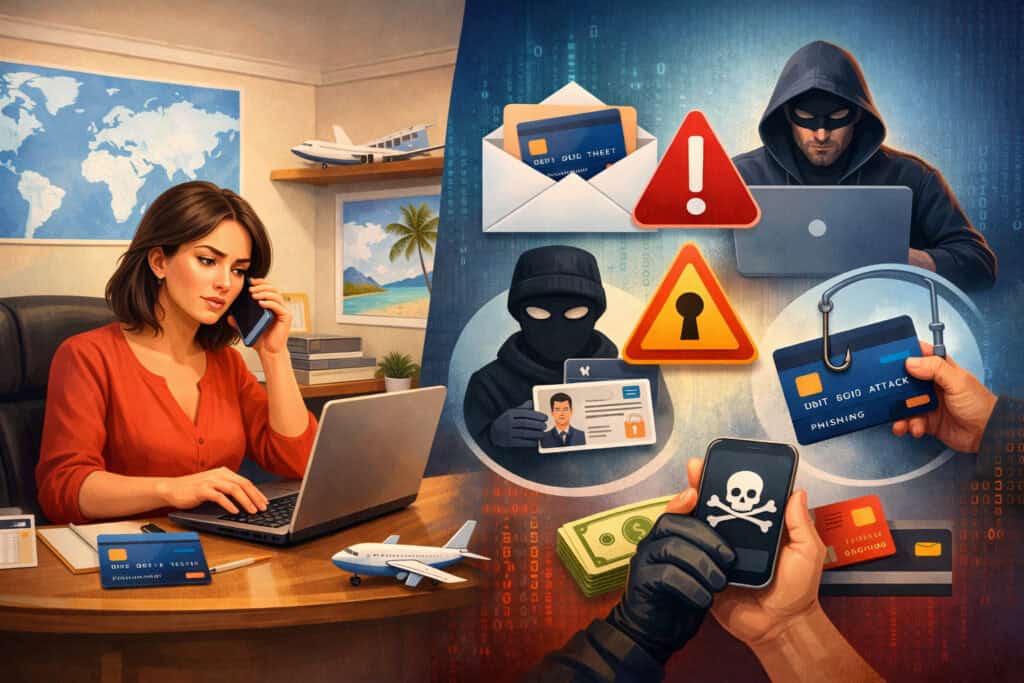
When you securely process credit cards via email or phone, you’re typically running a card-not-present transaction, often categorized as MOTO (Mail Order / Telephone Order).
In these transactions, the card is not physically dipped, tapped, or swiped, which means you lose powerful fraud signals like EMV chip verification and in-person identity cues.
That’s one reason card brands and banks scrutinize disputes more closely for travel-related purchases—especially those with future delivery dates (the trip happens weeks or months later).
Travel also has unique dispute triggers. Clients may dispute charges because they don’t recognize a merchant descriptor, because a supplier change wasn’t communicated clearly, or because a cancellation policy felt confusing.
Even legitimate changes—rescheduled flights, altered hotel categories, added baggage—can look suspicious to a cardholder reviewing a statement later. So the way you securely process credit cards via email or phone must include not only security controls, but also documentation controls.
Another risk is accidental data exposure. A single “quick” email—“Send me your card number and CVV”—can create a permanent record in an inbox that syncs to multiple devices, backups, and third-party apps.
The same goes for call recordings that capture PAN (primary account number) or security codes. If card data lands in places you can’t control, your PCI compliance scope expands and your breach risk skyrockets.
Finally, fraudsters target travel because the resale value of flights and hotel bookings can be high and because itineraries can be changed quickly.
If your process to securely process credit cards via email or phone is loose (no verification, no confirmation steps, no documented consent), you’ll see more chargebacks, more time wasted, and potentially higher processing costs.
Compliance Foundations You Must Know Before You Securely Process Credit Cards via Email or Phone
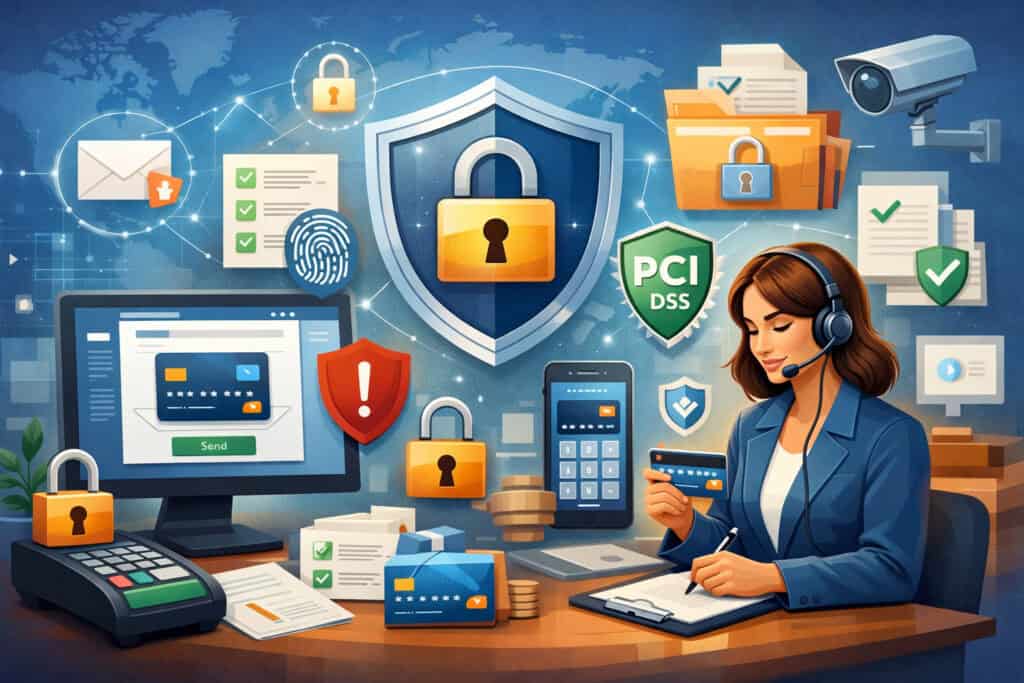
To securely process credit cards via email or phone, your baseline is PCI DSS (Payment Card Industry Data Security Standard). PCI DSS is maintained by the PCI Security Standards Council, and it sets expectations for how merchants protect cardholder data.
The current generation, PCI DSS v4.x, includes “future-dated” requirements that became mandatory on March 31, 2025—a key deadline emphasized by the PCI SSC itself. In plain terms, PCI is about reducing where card data can live and tightening the controls around any system that touches it.
For most travel agencies, the smartest approach is to avoid storing card data entirely and to route payments through PCI-compliant tools like hosted payment pages, payment links, tokenization, and virtual terminals. The moment you start saving card numbers in your CRM notes or email threads, you increase your responsibilities—and your risk.
Card-brand rules matter too. If you store a card for later charges (like charging a deposit now and the final balance later), you are entering “stored credential” territory.
Visa has a stored credential transaction framework that expects you to identify the initial storage/consent and properly classify later transactions. Merchants often describe these as CIT (customer-initiated transaction) and MIT (merchant-initiated transaction).
If your agency is subject to specific privacy or safeguarding obligations (for example, depending on the type of financial services relationships you have), you may also need to align with federal safeguarding expectations under the FTC’s Safeguards Rule and related guidance for covered entities.
Even when a specific rule doesn’t apply to your exact business model, the practical standard remains: use “reasonable” administrative, technical, and physical safeguards, and prove you can securely process credit cards via email or phone without exposing consumer information or mishandling disputes.
The Safest Phone Workflow: MOTO + Virtual Terminal + Tokenization
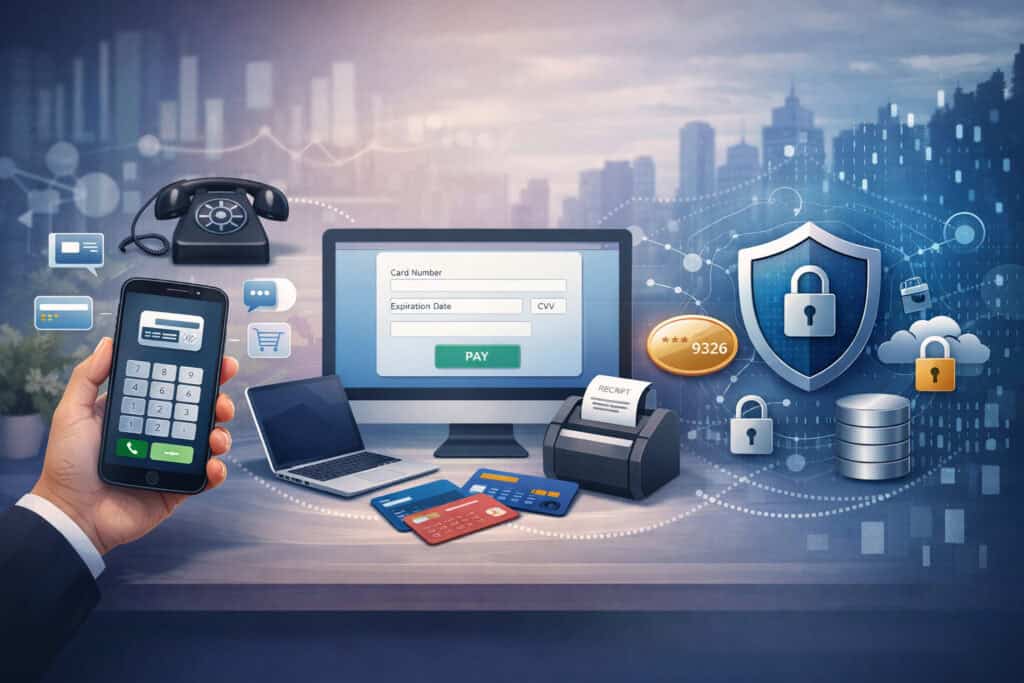
If you want to securely process credit cards via email or phone, phone payments can be very safe—if you structure them correctly. A best-practice phone workflow usually uses a PCI-compliant gateway and a virtual terminal.
The agent collects the minimum necessary details, enters them directly into the secure terminal, and never writes the card number down.
Here’s what “secure by design” looks like in real travel sales:
- Quote and confirm the itinerary first: You reduce “variable amount” disputes by confirming totals, cancellation terms, and supplier restrictions before payment.
- Authenticate the caller: Ask knowledge-based questions tied to the booking (email on file, traveler name spelling, last four digits of phone, billing ZIP, or a one-time code sent to their email/phone).
- Enter the card data only into the virtual terminal: Not into notes. Not into chat. Not into a local POS app that exports logs.
- Use AVS and CVV checks: AVS (Address Verification Service) and CVV checks aren’t perfect, but they improve fraud screening and can strengthen your dispute narrative.
- Tokenize for future charges: If you need to bill additional amounts later (change fees, add-ons, balance), store a token (not the PAN). Tokenization reduces your exposure while supporting repeat billing.
Phone recordings are a common hidden trap. If you record calls for quality, you must ensure recordings do not capture card numbers or security codes.
Many call center systems offer “pause/resume” or DTMF masking (the customer enters digits via keypad into a secure capture flow). This is one of the biggest upgrades you can make to securely process credit cards via email or phone while keeping training and QA.
A realistic example: A client books a family vacation with a deposit today and a final payment in 45 days. You run the deposit as a customer-initiated payment, store a token with documented consent, then run the remaining balance as a properly categorized follow-on charge—without ever storing raw card data.
The Safest Email Workflow: Payment Links and Hosted Invoices (Not Card Numbers in Messages)
To securely process credit cards via email or phone, email should almost never be the channel where card data is transmitted. Email is inherently replicating: it gets forwarded, cached, backed up, and synced across multiple devices. Even “deleted” emails can live in archives and backups for years.
Instead, use email for what it’s good at: delivering secure payment experiences through links and hosted pages. Common options include:
- Pay-by-link: You email a secure link generated by your gateway or processor.
- Hosted invoice pages: The client receives an invoice page with itemized travel components, deposits, and due dates.
- Secure authorization forms: A hosted form that captures consent, billing details, and a signature (digital), while storing only a token.
A strong email payment flow typically looks like this:
- Send a payment request that summarizes itinerary, dates, traveler names, and cancellation policy.
- Provide a secure payment link that expires after a defined window (for example, 72 hours).
- Use dynamic descriptors or clear invoice IDs so the cardholder recognizes the charge.
- Automatically email a receipt and policy confirmation immediately after payment.
This approach helps you securely process credit cards via email or phone while improving the customer experience. Many travelers feel safer entering their card into a professional payment page than reading card digits aloud.
A real-world example: You’re holding a limited-time fare for a client. Instead of requesting card details, you send a pay-by-link with the fare hold expiration time, plus a “confirm traveler names exactly as on ID” reminder.
The client pays quickly, your staff never handles sensitive data directly, and the payment record is tied to the booking documentation—excellent for disputes.
If you must collect payment authorization documentation (like for some supplier payments), use a secure form solution that encrypts data in transit and minimizes storage, while still capturing consent artifacts.
Stored Credentials for Deposits, Balances, and Add-Ons: Do It the “Card-Brand Correct” Way
Travel payments often involve multiple charges: deposit now, balance later, plus add-ons (seat upgrades, baggage, excursions). To securely process credit cards via email or phone in these scenarios, you need a stored credential strategy that aligns with card-network expectations.
Visa’s stored credential framework describes requirements around initial credential storage and subsequent use, including proper transaction indicators and referencing the original consent/transaction relationship. This matters because banks want clarity: did the cardholder authorize the future charge? Can the merchant prove it?
Operationally, this means:
- Collect explicit consent to store and reuse the credential (even if you store a token).
- Explain timing and amounts (or the method to calculate amounts).
- Use a clear schedule for final payments and change fees.
- Keep proof (timestamped acceptance, email confirmation, signed authorization, or recorded consent without capturing card numbers).
You’ll typically see two concepts:
- Customer-initiated charges: the customer triggers the payment (e.g., pays an invoice link).
- Merchant-initiated charges: the merchant charges later based on a prior agreement (e.g., final balance on a due date).
If your processor supports these indicators, use them. When you securely process credit cards via email or phone with correct stored credential handling, you often see better authorization outcomes and fewer “I didn’t authorize this” disputes—because the transaction metadata more accurately matches the situation.
Example: A group tour booking requires a deposit and then two scheduled installments. Your invoice system sends the first payment link (customer initiated).
The remaining installments are charged automatically using the stored token, with the schedule and consent provided at booking. Every charge triggers a receipt with a recognizable descriptor and invoice reference.
Technical Controls That Make Email/Phone Payments Safer
When you securely process credit cards via email or phone, the security outcome depends heavily on your technical controls. You don’t need enterprise complexity, but you do need the right building blocks.
The most impactful controls are:
- Hosted payment fields / hosted pages: Keeps card entry off your website and away from your devices.
- Tokenization: Replaces the card number with a token for future transactions and refunds.
- Encryption in transit and at rest: Ensure the systems you use encrypt sensitive data.
- Role-based access control (RBAC): Only the right staff can process refunds, view customer details, or resend payment links.
- Multi-factor authentication (MFA): Required for gateway logins, email admin accounts, and CRM access.
- Device and network hygiene: Updated systems, endpoint protection, and secure Wi-Fi.
PCI DSS v4.x pushes organizations toward continuous security hygiene, stronger authentication, and tighter management of system components in scope. The less card data you handle, the smaller your PCI scope becomes—and the easier it is to maintain compliance.
Real-world example: Your agency uses a CRM plus an email platform. A staff member copies card details into the CRM notes “temporarily.” That one behavior can pull your CRM, your backups, your support tools, and your admin users into compliance scope. Instead, your CRM should store a payment token reference or invoice ID—never raw card data.
Staff Scripts, Training, and Policies: The Human Layer of Security
Even the best payment stack fails if your team uses it inconsistently. To securely process credit cards via email or phone, you need simple, repeatable scripts and policies that fit real sales conversations.
Start with two non-negotiables:
- Never request card numbers by email or text.
- Never store card data in notes, screenshots, or recordings.
Then implement practical training:
- Phone script for secure capture: “For your security, I’ll enter your card details directly into our encrypted payment portal. I won’t write them down or repeat them back.”
- Email script for payment links: “For secure payment, please use this link. For your protection, do not email card details.”
- Verification script: Confirm billing ZIP, passenger name spelling, and send a one-time confirmation code for higher-risk bookings.
- Refund and change policy script: Clear language on what’s refundable, supplier penalties, and timelines.
Also define internal controls:
- Who can process manual keyed transactions?
- Who can issue refunds?
- Who can edit booking totals after payment?
- How are exceptions handled (VIP clients, last-minute bookings, supplier failures)?
These controls support consistent evidence in disputes. When you securely process credit cards via email or phone, your best chargeback defense is a clean record: invoices, policy acceptance, traveler details, and receipts tied to the booking.
Example: A client calls to add an excursion to an already-paid itinerary. The agent verifies identity, charges the add-on via the virtual terminal using a stored token, then emails an updated invoice and confirmation. The result is secure, consistent, and dispute-resistant.
Fraud Prevention for Travel: Red Flags, Controls, and Real Booking Scenarios
If you securely process credit cards via email or phone in travel, you should assume fraud attempts will happen. The goal isn’t to eliminate risk entirely; it’s to reduce loss while maintaining conversion.
Common travel fraud red flags include:
- Urgent same-day bookings with high totals
- A payer name that doesn’t match the traveler name
- Multiple cards attempted for one booking
- Requests to change the email address right before payment
- A customer pushing for unusual refund methods
- A booking that involves reshipping documents or “sending a driver”
Controls that help:
- AVS/CVV + velocity rules: Limit retries and flag multiple declines.
- Manual review thresholds: For bookings above a certain amount, require stronger verification.
- Email domain and phone validation: Look for mismatches between claimed identity and contact channels.
- Billing-to-travel alignment checks: Compare billing address, traveler country/city, and departure location patterns (without turning it into discrimination—use consistent rules).
- Hold and confirm for risky itineraries: Confirm ticketing windows and identity before final issuance.
A practical scenario: A caller wants a luxury resort booking for next week, pays with a card, and requests that confirmation be sent to a different email “because they’re traveling.” That’s not always fraud, but it’s high-risk.
To securely process credit cards via email or phone, you can require a one-time code to the original email on file, confirm billing ZIP and phone, and delay ticketing until verification is complete.
Fraud prevention is also customer protection. Many clients appreciate small safety steps if you explain them clearly: “We do a quick verification on higher-value bookings to protect you from unauthorized use.”
Chargebacks and Disputes: How to Win More Cases When You Take Payments Remotely
When you securely process credit cards via email or phone, you must design for chargebacks from the beginning. In travel, disputes often come down to documentation quality and clarity.
Your dispute-ready checklist should include:
- Itemized invoice showing dates, supplier names, and what’s included
- Proof of policy acceptance (cancellation, change fees, supplier penalties)
- Proof of delivery or service (itinerary confirmations, ticket issuance records, hotel confirmations)
- Customer communications that show the client requested the booking or acknowledged changes
- Clear descriptor that matches your brand name or booking reference
A frequent “friendly fraud” pattern is: customer books, travels (or partially travels), then disputes because they forgot or didn’t recognize the charge. A strong descriptor and immediate receipt reduces this dramatically.
Also be careful with partial refunds and adjustments. If you adjust a booking total due to supplier changes, ensure your records show why, when, and what the customer agreed to. If you’re using stored tokens for later charges, keep the consent artifact that proves the client agreed to the payment schedule and amounts.
Card networks place emphasis on transparent stored credential practices. Visa’s framework is intended to better identify initial storage and subsequent use, which can support stronger authorization and clearer dispute context.
A business example: A client disputes a “change fee” charged after they requested a date change. If you can show the email where they requested the change, the fee disclosure, and the receipt tied to the booking ID, you materially improve the chance of a win.
That’s part of learning to securely process credit cards via email or phone in a way that protects revenue.
Data Retention, Privacy, and Incident Response for Remote Card Payments
To securely process credit cards via email or phone, you need a retention plan. Retention sounds boring until you realize most “breach” situations happen because sensitive information was kept longer than necessary in places no one remembered—old inboxes, shared folders, exported CSVs, or archived ticketing systems.
Your goal is “minimum necessary” retention:
- Keep booking documentation and consent artifacts needed for disputes and accounting.
- Avoid retaining card data entirely (use tokens and references).
- Keep access logs and refund logs for accountability.
- Remove outdated staff access immediately when roles change.
If you use vendors, ask about their retention defaults. Some systems store invoice history forever unless configured. That might be fine for invoices, but not for anything that could contain sensitive fields.
If a security incident occurs, you need a simple incident response plan:
- Contain the issue (disable compromised accounts, revoke sessions).
- Preserve evidence (logs, timestamps).
- Notify the right parties (processor/acquirer, possibly legal counsel).
- Follow applicable breach notification expectations based on the type of information involved and where customers reside.
For covered entities, the FTC provides guidance on safeguarding customer information under the Safeguards Rule. Even if you’re not directly covered, it’s a useful benchmark for building a “reasonable safeguards” program.
In practical terms, if you want to securely process credit cards via email or phone, make sure your privacy approach matches your payment approach: minimize sensitive data, control access, and document your controls.
Choosing Processors and Tools Built for Travel’s Remote Payment Reality
A key step to securely process credit cards via email or phone is selecting a processor and gateway that actually support travel workflows. Many generic solutions work fine for simple e-commerce, but travel needs more: split payments, delayed fulfillment, tokenized follow-on charges, and dispute documentation support.
When evaluating providers, look for:
- Virtual terminal + pay-by-link + invoicing in one ecosystem
- Token vault with clear stored credential support
- Fraud tools (AVS/CVV rules, velocity controls, risk scoring)
- User permissions (RBAC), MFA, and audit logs
- Chargeback support tooling (document uploads, case tracking)
- Support for partial captures, incremental charges, and refunds
- Clear underwriting for your travel model (to avoid sudden holds)
Also consider how the provider handles stored credentials and transaction indicators. Visa and other networks have frameworks to identify stored credential transactions and link subsequent charges to the initial customer interaction. If your provider can’t support that cleanly, you may see more declines, more disputes, or messy workarounds.
A real-world example: A boutique agency offering custom itineraries might take a planning fee upfront, then apply that fee toward the final booking. Your processor should handle separate line items, clear receipts, and flexible payment schedules.
That makes it easier to securely process credit cards via email or phone without confusing the cardholder—and confusion is a leading cause of disputes.
Future Predictions: Where Email/Phone Payments Are Heading for Travel Agencies
Over the next few years, the ability to securely process credit cards via email or phone will improve—but expectations will rise too. Three major trends are shaping the future.
- Tokenization becomes the default: Network tokens and gateway tokens are increasingly common because they reduce exposure and can improve authorization rates.
Visa also points to benefits such as account updating services tied to stored credentials, which can reduce failed payments when cards are reissued. - Stronger authentication and smarter risk decisions: Processors are applying machine learning to detect anomalies in booking behavior.
That can mean fewer fraudulent approvals but also more false declines if your process is inconsistent. Agencies that standardize verification steps and customer communication will benefit. - More enforcement of security baselines: PCI DSS v4.x increased focus on continuous security practices, and its v4.x “future-dated” requirements became mandatory after March 31, 2025.
Expect more vendors and acquirers to require evidence of MFA, access control, and secure configurations before onboarding or during annual reviews.
Looking forward, “email” will be less about transmitting anything sensitive and more about secure delivery: invoices, payment links, and verification codes.
“Phone” will increasingly use IVR-style secure capture so agents never hear or handle full card numbers. Agencies that adopt these patterns will be best positioned to securely process credit cards via email or phone while keeping conversion high.
FAQ
Q.1: How can I securely process credit cards via email or phone without asking customers for card details in an email?
Answer: To securely process credit cards via email or phone without collecting card details in an email, you replace “send me your card number” with “use this secure payment method.”
The most common approach is a pay-by-link or hosted invoice page generated by your payment gateway. Your email contains the itinerary summary, the total amount, and a secure link where the customer enters card details directly into a PCI-compliant page.
This reduces risk because the card number never enters your inbox, your CRM, or your staff’s devices. It also improves the customer experience: many travelers trust a professional checkout page more than dictating digits over the phone or sending them in writing.
Add practical controls like link expiration (for time-sensitive fares), automatic receipts, and a booking reference on every message so the customer recognizes what they paid for.
If you need authorization proof, use a secure form that captures consent and signature while storing only tokens or transaction IDs. The key is designing the workflow so your business can securely process credit cards via email or phone while keeping raw card data out of your systems entirely.
Q.2: Is it ever acceptable to take a credit card number over the phone if we want to securely process credit cards via email or phone?
Answer: Yes—taking card details over the phone can still be a compliant and practical way to securely process credit cards via email or phone, as long as your workflow prevents storage and prevents accidental capture in recordings or notes.
The safest method is entering the card details directly into a secure virtual terminal during the call, then relying on tokenization for future transactions.
Where agencies get into trouble is writing numbers on paper “just for a minute,” typing them into chat tools, or recording calls that capture PAN and CVV.
If you record calls, configure pause/resume controls or use a secure keypad-entry method so sensitive digits aren’t recorded. Train agents to never repeat the full card number back and to immediately confirm the total amount, cancellation policy, and traveler details.
A well-run phone payment flow can be excellent for accessibility and urgent bookings. The difference is discipline and tooling. With the right controls, you can securely process credit cards via email or phone by phone while still minimizing compliance scope and breach risk.
Q.3: What do “stored credentials” mean for travel agencies that securely process credit cards via email or phone for deposits and later balances?
Answer: Stored credentials come into play when you charge the same card more than once—common in travel for deposits, balances, change fees, and add-ons. To securely process credit cards via email or phone in these cases, you typically store a token (not the card number) and keep proof that the customer agreed to future charges.
Card networks have frameworks for identifying when a card is stored and how subsequent charges are classified and linked to the initial customer consent.
Visa’s stored credential transaction framework describes requirements to identify initial storage and later use. This helps banks understand what’s happening and can reduce confusion-related disputes.
Practically, your invoices and confirmations should clearly state: the deposit amount, the due date for the balance, what happens if prices change, and what fees may apply.
When you store the token, document consent (timestamped acceptance or signed authorization). This combination—tokenization plus clear consent—lets you securely process credit cards via email or phone while handling real travel payment schedules.
Q.4: Which PCI DSS updates matter most when we securely process credit cards via email or phone?
Answer: For agencies trying to securely process credit cards via email or phone, the biggest PCI DSS lesson is: minimize your scope by keeping card data out of your systems. PCI DSS v4.x includes requirements that became mandatory after March 31, 2025, and the PCI SSC has emphasized preparing for those future-dated controls.
You don’t need to memorize every control. Focus on outcomes that reduce risk:
- Use hosted payment pages and tokenization so your staff doesn’t store PANs.
- Require MFA on payment gateways, email admin accounts, and any system that touches payment operations.
- Maintain access control and logging so you can see who processed what and when.
- Train staff and enforce policies that prevent card data from entering email, notes, or recordings.
If you can architect the workflow so your business never stores card data, it’s much easier to securely process credit cards via email or phone and demonstrate compliance during annual reviews.
Q.5: How do we reduce chargebacks when we securely process credit cards via email or phone for travel services delivered later?
Answer: Chargebacks often happen because the cardholder forgets, doesn’t recognize the descriptor, misunderstands the cancellation policy, or disagrees with changes. To securely process credit cards via email or phone in a dispute-resistant way, build documentation into every step.
Use itemized invoices with booking references, send immediate receipts, and ensure your descriptor is recognizable. Capture policy acceptance (cancellations, supplier penalties, date-change fees) in writing.
For stored credential scenarios (deposit now, balance later), document the schedule and consent clearly, and keep receipts for every charge.
Also tighten your internal controls: require verification for high-value bookings, and keep a consistent process for itinerary changes. When a client disputes a “change fee,” your best defense is a clean, time-stamped trail: the customer requested the change, you disclosed the fee, and you delivered the updated confirmation.
These practices don’t just help you securely process credit cards via email or phone—they help you keep revenue you already earned.
Q.6: What’s the best “future-proof” way to securely process credit cards via email or phone as fraud tools and standards evolve?
Answer: The most future-proof way to securely process credit cards via email or phone is to design your operations around three principles: tokenization, secure customer-present entry (hosted pages/IVR), and strong identity verification for high-risk cases.
Tokenization reduces your exposure and makes it easier to adapt as networks expand stored credential and account updating capabilities.
Visa’s stored credential guidance also signals ongoing emphasis on properly identifying and managing credential-on-file transactions. Meanwhile, PCI DSS v4.x’s direction is clear: stronger, ongoing security practices are expected, especially after the March 31, 2025 milestone for future-dated requirements.
Operationally, this means building processes that don’t depend on one person “remembering the rules.” Use standardized scripts, automated receipts, RBAC, MFA, and audit logs.
As AI-driven fraud tools become more common, consistent patterns (clear consent, stable verification steps, recognizable descriptors) will help your approvals and reduce false declines.
If you implement these foundations now, you can securely process credit cards via email or phone even as fraud patterns change and security standards tighten.
Conclusion
To securely process credit cards via email or phone, travel agencies need more than a payment terminal—they need a workflow that prevents sensitive data from leaking into email threads, call recordings, and internal notes, while also producing clear documentation that reduces disputes.
The most reliable blueprint is simple:
- Use pay-by-link or hosted invoices for email payments.
- Use a virtual terminal for phone payments, with tokenization for future charges.
- Avoid storing card data; store tokens, transaction IDs, and invoices instead.
- Add verification steps for higher-risk bookings.
- Make policy acceptance and receipts automatic and consistent.
- Align with PCI DSS v4.x expectations and card-brand stored credential frameworks so your process remains modern and defensible.
If you implement these steps, you can securely process credit cards via email or phone in a way that protects customers, reduces fraud, improves approval rates, and helps your agency scale confidently—without turning payment collection into a daily risk.