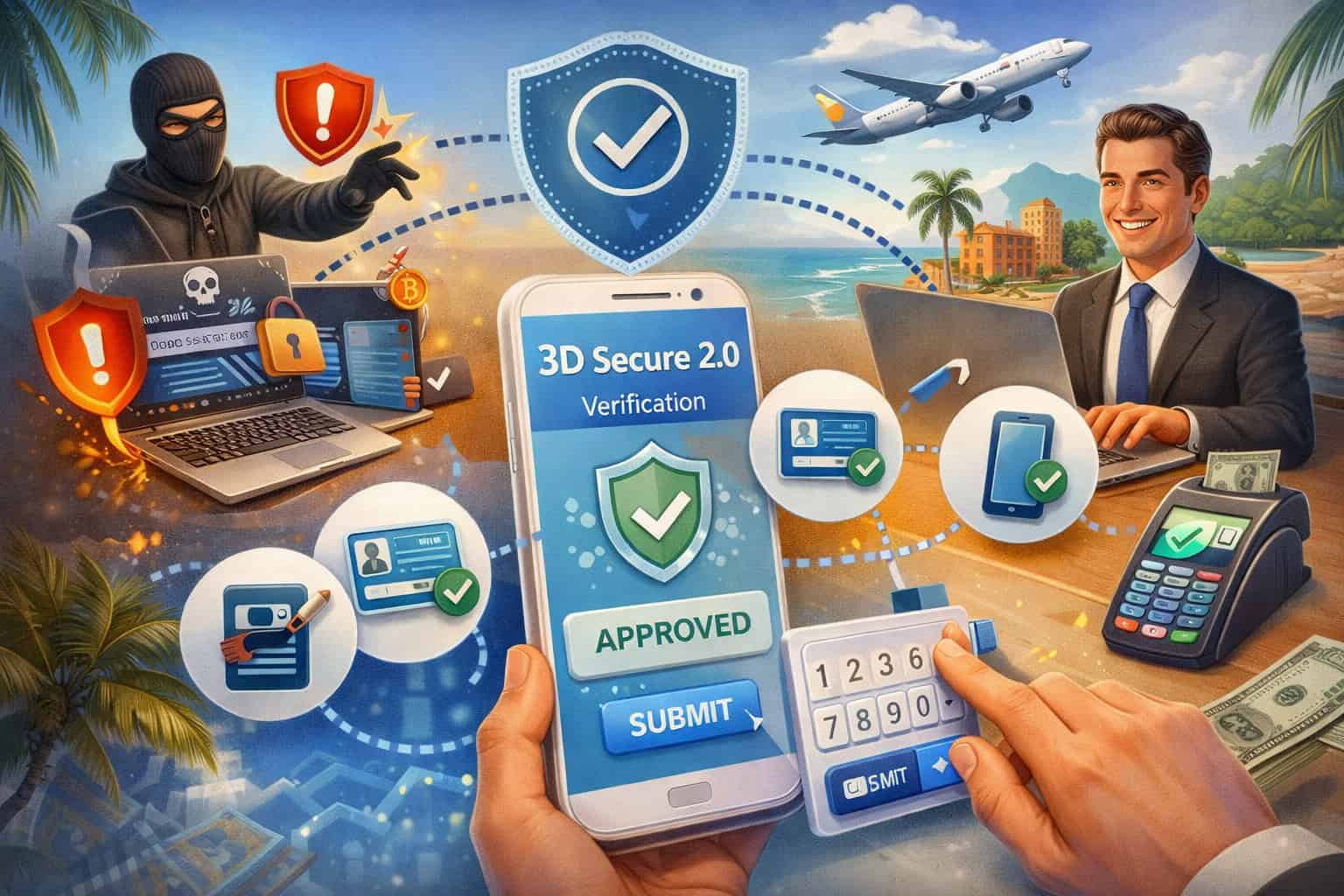
Online travel payments come with a risk profile that is very different from ordinary retail. A traveler may book weeks or months before departure, the billing address may not match the destination, multiple suppliers may be involved, and itinerary changes can trigger confusion long after the payment is approved.
That creates a difficult environment for fraud screening, customer authentication, and dispute management.
For travel merchants, the problem is not just stolen cards. It is also friendly fraud, chargebacks tied to service misunderstandings, and card-not-present losses that can erode margins fast. Even a healthy booking pipeline can become fragile if too many transactions are disputed or too many legitimate customers are declined at checkout.
That is why 3D Secure 2.0 for travel merchants matters so much. It adds a layer of cardholder authentication to online transactions, helps issuers make better risk decisions, and can shift liability in certain fraud-related cases away from the merchant when the requirements are met.
Modern EMV 3-D Secure was designed to support richer data sharing, mobile use cases, and smoother customer experiences than earlier versions.
For travel businesses, the real value is practical. Done well, 3DS2 can help reduce fraud exposure, cut some chargeback risk, improve trust in higher-risk bookings, and support better approval decisions without turning checkout into a frustrating obstacle course.
It is not a cure-all, and it does not replace good operations. But it can become a powerful part of a broader travel payment authentication strategy.
What 3D Secure 2.0 is and why it matters in travel payments
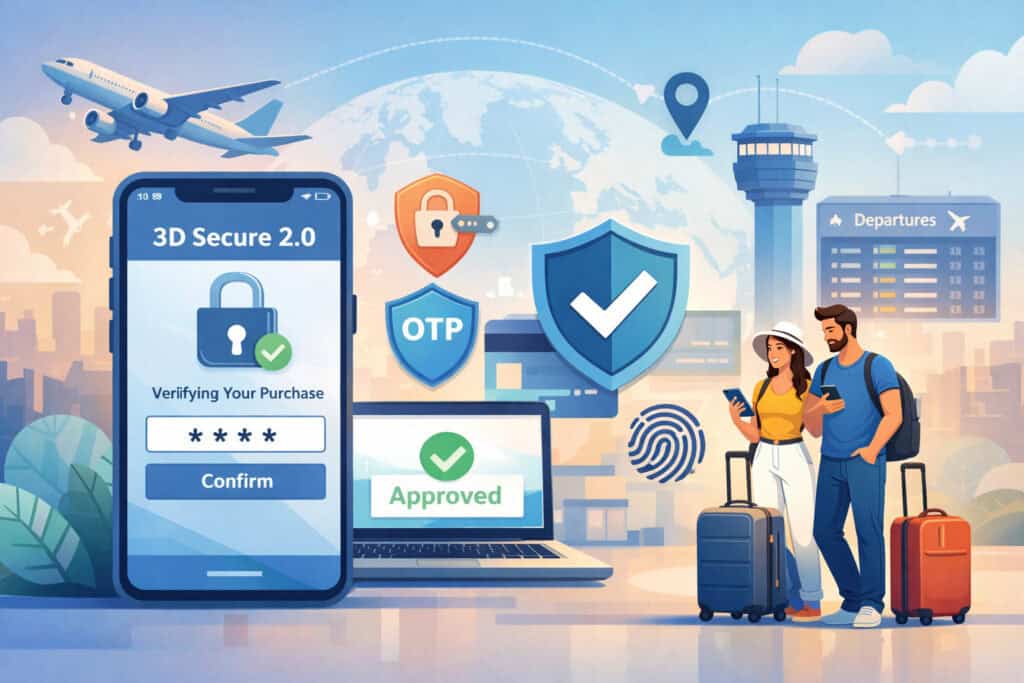
3D Secure 2.0 for travel merchants is an authentication framework used in online card payments to confirm that the person making the purchase is the legitimate cardholder. It sits between the merchant, the acquiring side, and the card issuer.
When a traveler enters card details, 3DS2 allows additional information about the transaction to be shared with the issuer so the issuer can decide whether to approve the payment silently or request extra verification.
The name “3D Secure” refers to the three domains involved in the process: the merchant and acquirer domain, the issuer domain, and the interoperability domain that connects them. In practice, travel merchants do not need to memorize the protocol architecture.
What matters is this: 3DS2 helps the issuer evaluate more context before authorizing a card-not-present transaction, and that can reduce fraud risk while supporting smoother approvals for legitimate customers.
Travel bookings are especially well suited to risk-based authentication because many transactions look unusual on the surface. Customers may book expensive vacations on mobile devices, reserve travel for other people, use cards issued far from the destination, or split payments across deposits and final balances.
A basic rules engine might flag too many of these purchases. By sharing more data through 3DS2, the issuer has a better chance of identifying which bookings are genuine and which deserve extra scrutiny.
EMVCo describes EMV 3DS as a tool to help prevent card-not-present fraud and increase e-commerce payment security, while Visa notes that 3DS enables data exchange between merchants and issuers before authorization to improve fraud decisioning.
This matters because travel merchants often live in the gap between payment acceptance and service delivery. When something goes wrong later, the original approval may not protect the merchant from a fraud claim. Authentication adds evidence and, in qualifying cases, may support liability shift.
How 3D Secure authentication works in online card payments
When a customer starts a booking, your payment stack sends the transaction into the 3DS2 flow before or alongside authorization, depending on your gateway design.
The system packages data such as device details, transaction amount, merchant information, account history, browser data, shipping or booking indicators, and other signals that help the issuer assess risk.
The issuer then decides between two paths. In a frictionless flow, the transaction is authenticated in the background without interrupting the customer. In a challenge flow, the issuer asks the customer to verify identity with something like a one-time code, banking app confirmation, or biometric approval.
EMVCo and Visa both describe this real-time risk-based model, where lower-risk transactions can pass without customer interaction and higher-risk ones receive additional verification.
For travel merchants, this is important because not every booking needs the same level of friction. A returning customer booking a modest domestic hotel stay may glide through silently, while a first-time buyer making a high-ticket international reservation close to departure may be challenged.
The key benefit is that the issuer makes this call using far more context than earlier versions of 3D Secure allowed.
Why travel merchants care more than many other online sellers
Travel businesses tend to sell higher-ticket items, longer-fulfillment services, and bookings that are harder for customers to mentally connect to a card statement later. That alone raises dispute risk.
Add cross-border bookings, third-party suppliers, partial refunds, date changes, cancellations, and family bookings where one person pays for another, and the fraud picture becomes more complicated than standard ecommerce.
A travel merchant also faces a dangerous mix of fraud and non-fraud disputes. A stolen-card booking can lead to a true fraud chargeback. But a legitimate traveler can also dispute a valid charge because they forgot the merchant name, misunderstood the cancellation terms, or expected a refund after a nonrefundable booking.
That means travel merchant fraud prevention tools must do more than block bad actors. They must support clean records, accurate descriptors, policy clarity, and payment authentication.
This is one reason a broader secure-payments approach matters. Helpful background on chargeback pressure, gateway setup, and travel payment risk can also be found in articles on secure payment processing for online travel agencies, how to fight travel chargebacks, and optimizing payment gateways for international travel bookings. These topics connect directly to how 3DS2 performs in the real world.
Why travel merchants face elevated fraud and chargeback risk
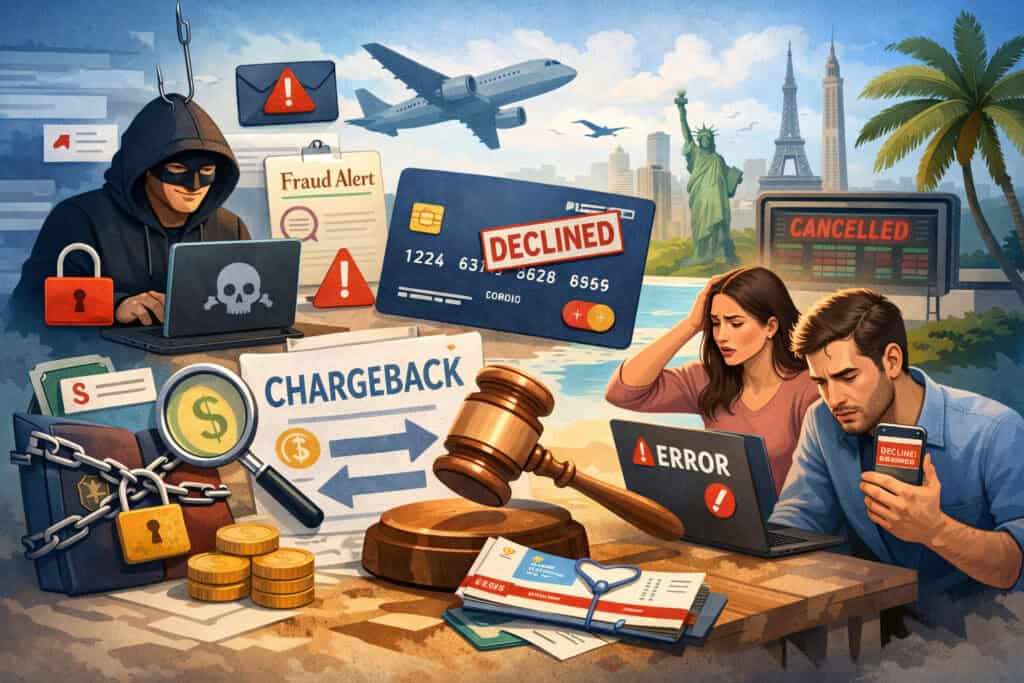
Travel is a favorite target for card-not-present fraud because the purchase can be high in value, delivered later, and sometimes consumed before the problem is discovered.
A fraudster may use a stolen card to book airline tickets, hotel rooms, tours, or vacation rentals, then disappear before the issuer finishes investigating. Even when a booking is canceled, the merchant may still spend time and money on supplier coordination, admin work, and dispute response.
Chargeback risk is also elevated because travel products are complex. People book for future dates, modify plans, misunderstand restrictions, and often involve several parties in one itinerary.
The merchant may have done nothing wrong, yet still face a dispute because the customer expected more flexibility than the booking terms allowed. That is why card-not-present fraud prevention travel strategies must blend authentication, fraud screening, policy communication, and post-sale recordkeeping.
In many travel businesses, the payment behavior itself can look suspicious even when it is legitimate. Someone may book from a phone while at an airport, use a corporate card with a traveler name mismatch, reserve a honeymoon package for another person, or pay a deposit now and a final balance later.
A rigid fraud filter can decline too many good bookings. A weak one can approve fraudulent ones. 3DS2 helps by giving issuers better context before the authorization decision.
Common card-not-present fraud patterns in travel bookings
Fraud in the 3D Secure 2.0 travel industry context often follows recognizable patterns. One is the urgent high-value booking made close to departure. Fraudsters like time pressure because merchants are less likely to pause and investigate.
Another is the first-time customer with limited history making a premium reservation from a device or location that does not match the cardholder profile.
Other common patterns include:
- Bookings for another traveler using a newly added card
- Multiple rapid booking attempts after failed authorizations
- One card used across several passenger names
- High-risk routes, destinations, or service categories
- Last-minute digital delivery, such as e-tickets or instant confirmations
- Repeated attempts from different devices with similar booking details
These patterns do not prove fraud on their own. In travel, many legitimate bookings look strange. That is why risk-based authentication can outperform blunt rules. Instead of forcing every odd-looking transaction into manual review or rejection, 3DS2 lets the issuer evaluate identity signals in context.
Why travel chargebacks are not always pure fraud
A major mistake in travel risk management is assuming every chargeback is a stolen-card problem. Many are actually service misunderstandings, cancellation disagreements, or recognition issues.
The customer may not recognize your descriptor, may have booked through an agent but forgotten the name used at checkout, or may believe a supplier disruption automatically entitles them to a refund.
This matters because reducing chargeback liability with 3DS2 is only part of the answer. 3DS2 can help address some unauthorized-use disputes, but it will not erase chargebacks tied to service delivery, refund timing, no-show claims, or policy confusion.
If your booking path is unclear, your invoices are vague, or your terms are buried, authentication alone will not save you.
Travel merchants need to think in layers. Authentication helps validate the payer. Clear disclosures help set expectations. Strong booking records help defend disputes. Clean payment operations help limit preventable losses. If one of those layers is weak, chargebacks can still rise even when authentication rates look good.
How 3D Secure 2.0 helps reduce liability for travel merchants
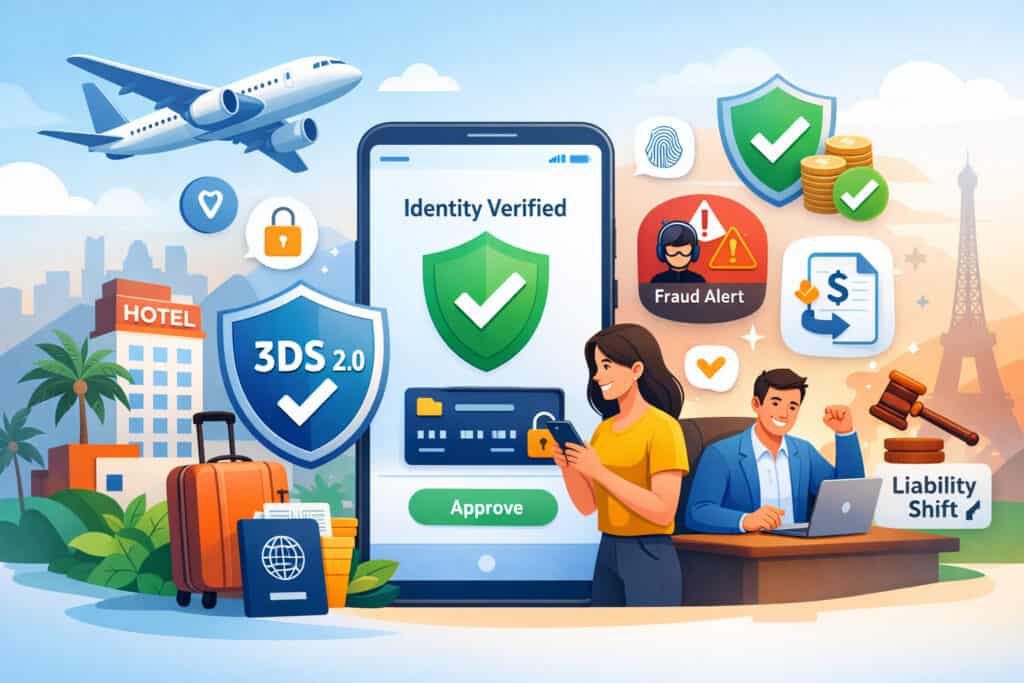
The biggest reason travel businesses adopt 3D Secure authentication for travel payments is not simply to look more secure. It is to reduce the merchant’s exposure when an online card payment later becomes the subject of a fraud-related dispute.
In qualifying cases, successful authentication can shift financial liability for certain unauthorized transactions from the merchant to the issuer. Visa and other payment providers describe this as one of the core protections offered by 3DS when authentication is successfully completed or when certain attempt conditions are met under network rules.
For travel merchants, that matters because unauthorized-use chargebacks can be expensive. The lost revenue is only part of the cost. There are also chargeback fees, staff time, possible supplier losses, and long-term damage to fraud ratios if disputes climb too high.
If 3DS2 causes the issuer to take the fraud-loss responsibility in a qualifying scenario, that can materially improve the economics of online travel sales.
Still, “liability shift” should not be understood as blanket immunity. It is conditional. The card network, issuer participation, authentication outcome, transaction type, and dispute reason all matter. Travel merchants need to know exactly what 3DS2 can and cannot do.
What liability shift means in practical day-to-day terms
In practical terms, liability shift means the merchant may no longer be the party that absorbs the fraud loss in certain card-not-present disputes after proper authentication. If a stolen card was used and the transaction went through a qualifying 3DS2 authentication flow, the issuer may carry the liability rather than pushing the loss back to the merchant.
That does not mean every dispute disappears. It does not mean the booking becomes nonrefundable. It does not mean the merchant wins every case automatically. It means that for certain unauthorized-transaction claims, the authentication result can change who is financially responsible.
For a tour operator, that might mean a suspicious booking with successful authentication is less likely to become a direct fraud loss later. For an online travel agency, it can create more confidence in accepting bookings that would otherwise feel risky.
For a vacation rental or resort merchant, it may reduce exposure on higher-ticket prepaid stays where fraud losses are painful.
When 3DS2 can help reduce chargeback liability and when it may not
3DS2 is most helpful when the dispute is tied to unauthorized use or fraud in a card-not-present setting. It can also support cleaner issuer decisioning upfront, which reduces some bad approvals before they become chargebacks at all. But it may not help in disputes involving:
- Service not received
- Refund not processed
- Cancellation disagreements
- Duplicate billing
- Processing errors
- Misrepresented product or service
- Recurring payment disputes outside the fraud context
That distinction is critical for travel merchants. A traveler who claims, “I did not make this purchase,” is very different from one who says, “I canceled and expected a refund,” or “I do not agree with the fare rules.” Authentication helps with the first scenario more than the others.
Here is a simple breakdown:
| Scenario | Does 3DS2 typically help? | Why |
| Stolen card used for an online booking | Often yes | Successful authentication may support liability shift for unauthorized-use disputes |
| Legitimate customer forgets the purchase | Sometimes indirectly | Authentication helps, but descriptor clarity and records still matter |
| Customer disputes a nonrefundable booking | Usually no | This is a policy or service dispute, not an authentication problem |
| Friendly fraud claim after a completed stay or trip | Sometimes limited | Authentication can support your position, but service evidence is still essential |
| Merchant processing error or duplicate charge | No | 3DS2 does not fix merchant-side billing mistakes |
| Refund delay or cancellation confusion | No | Operational handling and disclosures matter more than authentication |
Pro Tip: Review your chargeback reason codes before assuming 3DS2 will solve the problem. If most disputes are service-based, focus just as much on operations and communication as on authentication.
3D Secure 1.0 vs 3D Secure 2.0: what changed and why it matters
Many merchants still think of 3D Secure as the old popup or redirect screen that interrupted checkout and hurt conversions. That reputation comes from earlier implementations of 3D Secure 1.0.
The newer EMV 3DS framework was built to fix many of those problems by supporting richer data exchange, better mobile experiences, and more flexible risk-based authentication.
The difference is not cosmetic. It affects fraud outcomes, customer experience, and the practicality of deployment in modern travel commerce.
According to Mastercard developer materials and EMVCo documentation, EMV 3DS supports far more data sharing than the older version, allowing issuers to make better real-time risk decisions and enable more frictionless authentications.
For travel merchants, that is a major improvement. The old model was too rigid for the complexity of travel bookings. The newer version is far better suited to mobile booking paths, app-based experiences, and transactions that look unusual but are actually legitimate.
Side-by-side comparison: 3D Secure 1.0 vs 3D Secure 2.0
| Feature | 3D Secure 1.0 | 3D Secure 2.0 |
| Customer experience | Often redirect-heavy and clunky | Built for smoother browser and in-app flows |
| Data shared with issuer | Limited | Much richer set of transaction and device data |
| Mobile support | Weak | Stronger support for mobile and app authentication |
| Authentication style | More one-size-fits-all | Risk-based with frictionless and challenge options |
| Travel suitability | Less flexible for complex bookings | Better for varied booking patterns and higher-risk scenarios |
| Conversion impact | Often negative if overused | Can be optimized to protect both security and checkout completion |
| Fraud decisioning | Less contextual | More nuanced because the issuer sees more signals |
The move from older authentication to EMV 3DS is one reason secure online payments travel industry efforts have improved. Travel merchants no longer have to choose between security and customer experience as sharply as before. They still need to configure the system carefully, but the underlying protocol is far more adaptable.
How 3DS2 improves customer experience compared with older authentication methods
The best thing about 3DS2 from the customer perspective is that many good transactions do not require the traveler to do anything extra. When the issuer is confident enough based on the data provided, the transaction can be authenticated silently. That removes the awkward detours many merchants remember from older 3DS experiences.
Even when a challenge is required, the process is usually more integrated than legacy redirects. The customer may confirm through a banking app, enter a one-time code, or use biometric verification in a way that feels more natural on mobile devices.
Visa describes frictionless authentication as an issuer decision based on risk data without cardholder involvement, while EMVCo describes the challenge flow as a secure issuer-driven interaction when additional verification is needed.
For travel merchants, this matters because checkout abandonment is expensive. Travelers comparison-shop, book on mobile, and often complete transactions while multitasking. A smoother authentication path means less drop-off and fewer incomplete bookings.
Frictionless flow vs challenge flow, explained simply
The two core 3DS2 experiences are the frictionless flow and the challenge flow. Understanding the difference is essential because travel merchants often worry that authentication will always create customer friction. It does not. In fact, the goal of modern 3DS is to authenticate as many low-risk transactions as possible without interrupting checkout.
In a frictionless flow, the issuer decides that the transaction looks safe enough based on the data received. The booking continues without requiring the traveler to do anything extra.
In a challenge flow, the issuer wants more proof that the person using the card is the real cardholder, so the traveler must complete an additional verification step. EMVCo, Visa, and Mastercard all describe this model as a real-time risk decision supported by richer data than the old 3DS framework.
For travel merchants, the right mindset is not “frictionless good, challenge bad.” A challenge can save you from accepting a fraudulent booking. The real goal is to send enough relevant data that good transactions pass smoothly while risky ones are challenged intelligently.
What a frictionless authentication flow looks like in travel
Imagine a repeat customer books a mid-range hotel stay using the same device and card they used before. The booking amount is ordinary, the email history is consistent, the transaction timing is normal, and the issuer sees no strong fraud indicators.
Your gateway submits the 3DS2 authentication request with those signals, and the issuer approves it behind the scenes. The traveler never sees a verification prompt.
That is frictionless authentication at work. From the customer’s point of view, checkout feels normal. From your point of view, the transaction still benefits from issuer-side risk assessment and the possibility of liability protection where applicable.
Travel merchants can increase the chances of frictionless outcomes by passing clean, complete data. Incomplete booking data, poor account history signals, or inconsistent customer records can reduce the issuer’s confidence and trigger more challenges than necessary.
What a challenge flow looks like in travel
Now imagine a new customer books an expensive package for immediate travel from a device the issuer has never seen before. The billing address is in one region, the destination is far away, and the traveler name does not match the cardholder name. None of this proves fraud, but it does raise risk questions.
In this case, the issuer may initiate a challenge. The traveler might receive a push notification in a banking app, enter a one-time passcode, or confirm using biometrics. If the challenge succeeds, the booking can proceed with stronger confidence that the customer is legitimate. If it fails or is abandoned, the transaction may be declined.
For travel merchants, a well-managed challenge flow can be worth the extra step when the booking is high-value or unusual. The danger comes when too many normal bookings are challenged because the merchant is not sending enough useful data or is routing all transactions through needlessly strict settings.
Travel-specific use cases: how 3DS2 works differently in this industry
The 3D Secure 2.0 travel industry is not the same as standard retail ecommerce. A clothing merchant usually sells and ships a product quickly to the buyer.
A travel merchant often sells a future service, may deliver digital documents instantly, and may have one payer, one booker, and one traveler who are not the same person. Those differences affect how 3DS2 should be used.
Travel merchants often need nuanced authentication strategies rather than an all-or-nothing setting. Some bookings benefit from mandatory authentication. Others perform better with risk-based routing. Still others need enhanced review because the business model itself carries unusually high dispute exposure.
Online travel agencies
An online travel agency often handles a wide range of suppliers, trip types, ticket values, and customer origins. That creates broad risk variation. A simple domestic hotel booking by a returning customer is very different from a last-minute international itinerary with multiple passengers and add-ons.
For OTAs, 3DS2 is often most effective when tied to smart segmentation. High-value bookings, cross-border cards, bookings close to departure, and first-time customers may merit stronger authentication.
Lower-risk repeat buyers may be routed more flexibly. The agency should also pass travel-specific booking details into the payment flow whenever the gateway supports them, because richer context can improve issuer decisions.
Tour operators and activity providers
Tour operators often sell deposits, installment balances, seasonal packages, and bookings that are subject to weather, supplier coordination, and cancellation rules. Disputes here are often a mix of fraud and expectation gaps.
A traveler may claim unauthorized use, but many disputes stem from schedule changes, nonrefundable terms, or dissatisfaction about what was included.
For these businesses, 3DS2 works best when paired with strong documentation. Authentication helps on the front end. Clear invoices, signed waivers where appropriate, timestamped booking confirmations, and visible cancellation terms help on the back end. If a dispute arises, you want both payment authentication evidence and service-delivery evidence.
Vacation providers, resorts, and higher-ticket stays
Vacation providers often face elevated ticket sizes, advance bookings, family purchases, and gift-style purchases where one person pays and another travels.
These are exactly the kinds of transactions that can confuse basic fraud systems. 3DS2 helps by adding issuer-side intelligence to determine whether the payer is legitimate even when the booking pattern looks unusual.
For higher-ticket stays, the value of liability shift can be significant. A single fraudulent booking may be costly enough to justify a stronger authentication posture. But because conversion matters, merchants should avoid forcing every booking into a challenge. Instead, use 3DS2 in a way that reflects booking value, travel lead time, account history, and customer behavior.
How 3D Secure fits into a broader fraud prevention strategy
A common mistake is treating travel payment authentication as the entire fraud program. It is not. 3DS2 is powerful, but it works best as one layer in a broader fraud stack. Travel merchants still need device intelligence, velocity controls, booking analytics, manual review protocols, clear policies, refund discipline, and strong post-booking communication.
Think of it this way: 3DS2 helps answer, “Is the player likely to be the legitimate cardholder?” But travel risk management also requires answers to other questions:
- Is this booking pattern typical for this customer?
- Is this itinerary likely to be resold or abused?
- Is the destination, lead time, or ticket value unusually risky?
- Does the booking create a refund or service ambiguity later?
- Can we prove what the customer agreed to and what was delivered?
Where 3DS2 ends and other fraud tools begin
3DS2 is especially strong at supporting issuer-led identity verification and enabling liability benefits in certain fraud scenarios. Other tools cover areas 3DS2 does not fully address. Device fingerprinting helps spot suspicious environments.
Velocity rules identify repeated attempts. Behavioral analytics can flag bots or scripted attacks. Manual review teams can look at nuanced cases, such as group bookings or unusual name patterns.
Travel merchants should also align payment authentication with operational controls. For example, if a booking is high-risk, the business may require identity confirmation before ticket issuance, delay fulfillment until review, or verify passenger details against known fraud indicators. That is not a replacement for 3DS2. It is a complement.
Why authentication alone will not stop friendly fraud
Friendly fraud is especially painful in travel because the customer often did make the booking, used the service, and later disputes the charge anyway. Sometimes this is deliberate. Sometimes it is confusing. Either way, 3DS2 is only one piece of your defense.
To reduce these disputes, merchants should:
- Use recognizable billing descriptors
- Send immediate booking confirmations
- Display cancellation and refund terms clearly
- Keep records of traveler names, dates, and confirmations
- Log customer communications and change requests
- Document no-show or service-use evidence where available
Authentication strengthens the original transaction story. Operational proof strengthens the rest of it. The combination is much more effective than either one alone.
3DS2 implementation for merchants, step by step
3DS2 implementation for merchants is not just a switch you flip. The best results come from careful setup, clean data mapping, smart routing, and close coordination with your gateway or processor. Travel merchants should approach implementation as both a technical and operational project.
At a high level, you need a payment gateway or platform that supports EMV 3DS, a processor/acquirer configuration that aligns with your card-brand programs, and a checkout or booking engine that can send the right data at the right moment.
You also need reporting that lets you see authentication results, challenge outcomes, approval rates, and downstream dispute performance.
Step 1: Confirm what your payment partners support
Start by asking your gateway, processor, and booking platform very specific questions:
- Do you support EMV 3DS natively?
- What authentication flows are available for browser and mobile?
- Can you pass travel-relevant data fields?
- How do you report authentication outcomes and exemptions or attempt indicators?
- What liability-shift support exists by card brand?
- Can you apply rules by risk segment, ticket size, or booking type?
Do not settle for vague assurances that “3DS is available.” Travel merchants need to know how the feature behaves in real booking journeys. A checkout that technically supports authentication but cannot pass meaningful context may not perform well enough.
Step 2: Map the right booking and customer data
One of the biggest reasons 3DS2 underperforms is bad data mapping. The issuer cannot make a smart risk decision if the merchant sends thin, inconsistent, or low-quality information. Travel merchants should work with developers to map the most useful available signals, such as:
- Customer account age
- Previous booking history
- Device and browser details
- Billing and contact consistency
- Booking value
- Passenger or traveler mismatch indicators
- Lead time before travel
- Whether the customer is a repeat buyer
- Delivery method and timing
The goal is not to send noise. It is to send meaningful context that helps the issuer distinguish a genuine unusual booking from a fraudulent one.
Step 3: Decide where to use authentication more aggressively
Not every travel merchant needs the same authentication policy. A business with chronic fraud on last-minute bookings may require stronger 3DS2 enforcement in that segment. Another may focus on cross-border cards or high-ticket packages. Another may use broader authentication during peak fraud periods.
Start with clear business rules. Identify the bookings that hurt you most when they go bad, then determine whether those should be routed through stronger authentication. Use a phased rollout if needed. Test a segment, measure results, and expand carefully.
Step 4: Train your operations and support teams
Implementation is not complete when the code is live. Your customer support, chargeback, fraud, and reservations teams need to understand what 3DS2 does, what the customer sees, and how to interpret authentication outcomes. If a traveler calls saying, “My bank asked me to verify the payment,” your team should know how to guide them confidently.
Support teams also need to know that authentication does not override booking policies. A successfully authenticated payment can still become a service dispute later. Keeping those distinctions clear helps prevent internal confusion and poor chargeback responses.
What travel businesses need from gateways, processors, booking engines, and fraud tools
Travel merchants often depend on multiple vendors to complete one booking flow. The website may use one booking engine, the gateway may come from another provider, the processor may sit behind that, and fraud screening may be handled by yet another service. If these parts do not work together well, 3DS2 performance can suffer.
A strong secure online payments travel industry setup requires all parts of the stack to exchange the right signals.
That means the booking engine should capture relevant data cleanly, the gateway should support robust 3DS2 messaging, the processor should handle authentication results correctly, and the fraud tools should complement rather than conflict with issuer decisions.
Gateway and processor capabilities to look for
Travel businesses should prioritize payment partners that offer:
- Full EMV 3DS support for browser and mobile channels
- Detailed authentication reporting
- Clear liability-shift visibility
- Flexible rule controls by segment or risk profile
- Good support for international and cross-border bookings
- Reliable fallback handling when issuers or card types behave differently
- Easy integration with booking and fraud tools
Good payment partner support can make the difference between a useful authentication program and an expensive layer that only adds friction. If you want more context on travel payment setup, payment processing for travel businesses is a helpful related read.
Booking engine and fraud-tool requirements
The booking engine must capture clean customer data without creating unnecessary friction. If fields are inconsistent, optional when they should not be, or disconnected from the payment request, your authentication quality drops. Your fraud tools should also understand that a positive 3DS2 result changes the risk picture but does not eliminate all risk.
For example, if a booking passes a challenge successfully, you may reduce manual review pressure. But if the itinerary is a classic fraud pattern and fulfillment is immediate, you might still want extra checks. Likewise, a frictionless result should not automatically override every other concern if the booking triggers operational red flags.
Best practices for using 3DS2 without hurting conversions
The biggest merchant fear around authentication is lost bookings. That fear is understandable, especially in travel, where customers comparison-shop heavily and often book on mobile. The answer is not to avoid authentication. It is to use it intelligently.
The best 3D Secure 2.0 for travel merchants strategies balance fraud reduction with booking completion. That means maximizing frictionless approvals, applying stronger authentication where the risk justifies it, and reducing avoidable challenge failures.
Send richer data and keep it clean
The more relevant context you provide, the better the issuer can decide whether a traveler is low-risk. Clean data improves frictionless rates. Messy data creates uncertainty. That is why merchants should regularly audit the information passed into the 3DS2 request.
Check for missing phone numbers, inconsistent names, poor account history mapping, and broken device-data collection. Small technical problems can quietly damage performance for months if no one reviews them.
Use risk-based segmentation instead of blanket rules
Travel merchants should resist the urge to challenge everything. A blanket approach can create needless friction for loyal customers and low-risk bookings.
Instead, segment your traffic. Use stronger authentication for booking patterns that historically drive fraud losses or high-value exposure. Use more flexible routing for lower-risk segments where conversion matters more.
This does not mean being lax. It means being precise. Good risk segmentation protects more value with less friction.
Make the challenge experience as smooth as possible
Some challenges are unavoidable. When they happen, your checkout should set expectations clearly. Customers should understand that their bank may ask for verification and that this is for security. Your design should avoid confusing redirects, broken screens, or vague error messages.
A failed challenge is not always fraud. Sometimes the customer simply did not understand what was happening. Clear UI text, fast page loads, and mobile-friendly design all matter.
Monitor soft declines and approval behavior
Sometimes the issuer’s response pattern reveals that your authentication strategy needs adjustment. If you see too many declines after authentication, challenge abandonment spikes, or approval rates falling in certain segments, investigate. You may need better data, different routing, or a revised policy for when to step up authentication.
Common mistakes travel merchants make when deploying authentication tools
Even good merchants can get poor results from 3DS2 if the rollout is rushed or based on outdated assumptions. The mistakes are usually not dramatic. They are small operational and configuration errors that gradually reduce performance.
Mistake 1: Treating 3DS2 as a silver bullet
Authentication is not a substitute for strong travel operations. Merchants that deploy 3DS2 and ignore their descriptors, refund handling, cancellation disclosures, or service records often feel disappointed later. Fraud losses may improve while chargebacks remain painful.
The solution is to integrate authentication into the full customer journey. Confirm that pre-booking disclosures, confirmation emails, and post-sale service are just as strong as the payment controls.
Mistake 2: Sending poor or incomplete data
This is one of the most common and damaging errors. Merchants often assume the gateway handles everything automatically, but many key fields depend on the merchant’s own systems. If customer history is missing, device collection is broken, or traveler data is not passed, issuers lose context and challenge rates may rise.
A technical data audit should be part of every rollout and every major site update. Even a small checkout redesign can accidentally break useful 3DS2 data collection.
Mistake 3: Forcing too many challenges
Some merchants become so focused on fraud reduction that they end up over-challenging legitimate customers. In travel, that can hurt mobile conversion badly. A better approach is targeted step-up authentication based on actual fraud patterns, not fear.
Measure the value of each challenged segment. If a segment has very low fraud and high abandonment, your challenge policy may be too aggressive.
Mistake 4: Failing to review results after launch
Deployment is not success. You need ongoing analysis. Travel demand changes, fraud patterns shift, issuers behave differently, and booking mixes evolve. What worked well during rollout may need returning later.
Without reporting discipline, merchants can assume 3DS2 is helping when it is actually suppressing conversion or failing to reduce the most expensive dispute categories.
How to evaluate whether 3DS2 is working
The real test of 3DS2 implementation for merchants is not whether authentication requests are being sent. It is whether the program improves business outcomes. Travel merchants should measure performance across fraud, approvals, customer experience, and disputes.
Start by defining success before rollout. Do you want lower fraud losses, fewer unauthorized chargebacks, better approval rates on legitimate travelers, lower manual review volume, or stronger acceptance on high-risk segments? Ideally, you want several of these outcomes, but each may move differently depending on how the strategy is configured.
Core metrics to track
The most useful metrics usually include:
- Fraud rate by booking segment
- Unauthorized chargeback count and value
- Overall chargeback rate
- Authentication rate
- Frictionless rate
- Challenge rate
- Challenge completion or success rate
- Authorization approval rate
- Booking completion rate
- Abandonment rate during checkout
- Manual review rate
- Repeat-customer approval trends
Do not evaluate 3DS2 in the aggregate alone. Break the data down by booking value, lead time, geography, device type, card type, customer tenure, and product category. A program can look average overall while performing extremely well for one segment and poorly for another.
How to interpret the numbers correctly
A higher authentication rate is not automatically good. If it comes with a drop in completed bookings, you may be overusing step-up checks. A lower fraud rate is also not enough by itself if approval rates fall sharply and good customers are lost.
Look for balanced gains. The best outcome is often a mix of lower fraud losses, stable or improved approvals, healthy frictionless performance, and reduced unauthorized disputes. It is also helpful to measure how many previously risky segments are now acceptable because authentication has improved confidence.
Review travel-specific performance patterns
Travel merchants should pay special attention to:
- Bookings close to departure
- High-ticket itineraries
- Bookings made for another traveler
- Cross-border cards
- Mobile bookings
- First-time customers
- Deposits versus final balances
These are often the segments where 3DS2 creates the most value or the most friction. Detailed analysis tells you where to tune policy rather than making broad assumptions about the whole program.
Practical examples for different travel merchants
Sometimes the clearest way to understand 3D Secure authentication for travel payments is through real-world style examples. The goal is not to show one perfect setup. It is to show how different travel business models should think about authentication differently.
Example: a tour operator selling guided adventure trips
A tour operator sells multi-day guided packages with a deposit at booking and a final balance closer to departure. Fraud losses are not constant, but when they happen, they are expensive. The merchant decides to apply stronger 3DS2 controls to first-time customers, higher-value bookings, and bookings made within a short window before departure.
Repeat customers with clean history often pass through frictionless authentication. New high-value bookings are more likely to be challenged. The operator also improves cancellation disclosures and stores acknowledgment records in the booking system. Over time, unauthorized disputes fall, while service disputes become easier to separate from true fraud.
Example: an online travel agency with broad inventory
An OTA handles hotels, flights, and packages from many suppliers. Fraud pressure is highest on certain routes and urgent bookings. The company uses risk segmentation to apply stronger authentication to those segments while keeping lower-risk bookings flexible.
The OTA also connects account-history data to the 3DS2 request, improving frictionless outcomes for logged-in repeat buyers. Instead of challenging every cross-border booking, it focuses on patterns that historically drive losses. This lowers fraud exposure without unnecessarily burdening good customers.
Example: a vacation rental provider with longer lead times
A vacation rental provider sees disputes related to guest misunderstanding, cancellation disagreements, and occasional stolen-card bookings. The merchant implements 3DS2 for online reservations but also rewrites booking terms, improves the descriptor, and sends better confirmation emails.
As a result, fraud-related losses improve modestly, but the bigger win is cleaner dispute management overall. The business can now identify which chargebacks are authentication-related and which are policy or service problems. That helps the team respond more effectively and tune the right parts of the process.
Example: a resort taking direct prepaid bookings
A resort accepts prepaid direct bookings through its website. Because the average transaction value is high, the cost of a single fraud event is meaningful. The resort uses 3DS2 aggressively for premium room types and bookings made from unfamiliar devices or unusual geographies.
At the same time, it avoids heavy friction for returning guests and loyalty members by passing strong account-history data. Challenges are reserved for truly uncertain cases. The result is stronger protection on expensive bookings without damaging the guest experience for known customers.
Frequently Asked Questions
No. 3DS2 can help reduce fraud-related exposure and may support liability shift in qualifying unauthorized-transaction scenarios, but it does not eliminate all chargebacks. Travel merchants can still see disputes tied to cancellations, refund delays, service issues, policy misunderstandings, or billing errors.
No. It is especially valuable for merchants with elevated fraud exposure, but even lower-risk travel businesses can benefit from better authentication, stronger issuer decisioning, and cleaner support for certain fraud disputes. The right setup depends on your booking mix, ticket sizes, and dispute history.
It can if deployed poorly, but it does not have to. Modern EMV 3DS supports frictionless authentication, which allows many lower-risk transactions to complete without customer interruption. Merchants usually get better results when they send richer data and use risk-based segmentation instead of forcing challenges on every booking.
No. A successfully authenticated payment is stronger than an unauthenticated one, but it is not perfect protection. You can still face service disputes, operational errors, or friendly fraud. That is why 3DS2 should sit inside a broader fraud and chargeback management strategy.
Not always. Some merchants choose broad authentication coverage, while others use more targeted rules. The best answer depends on fraud patterns, booking values, mobile conversion sensitivity, and how well your systems can pass relevant data. Blanket policies are often less effective than smart segmentation.
Neither is universally better. Frictionless is ideal for legitimate low-risk bookings because it protects conversion. Challenge flow is valuable when the issuer needs more confidence before approving a riskier transaction. The goal is not to eliminate challenges entirely. It is to reserve them for the right cases.
Yes, but carefully. Travel often involves one person paying for another. That can confuse basic fraud tools, but 3DS2 gives issuers more context to evaluate legitimacy. Merchants should still watch for suspicious booking patterns and not assume every third-party traveler scenario is safe.
Ask about browser and mobile support, travel-data mapping, liability-shift reporting, challenge performance, card-brand handling, segment-based controls, and post-authentication reporting. You want more than basic availability. You want a setup that matches the realities of travel bookings.
Conclusion
For travel merchants, online card acceptance is never just about getting an approval. It is about deciding which bookings are safe to trust, which risks are worth taking, and how to protect the business when card-not-present disputes happen later.
That is why 3D Secure 2.0 for travel merchants is so valuable. It adds smarter authentication, improves issuer visibility into risky transactions, and can reduce liability exposure in the kinds of fraud scenarios that hurt travel businesses most.
Still, the biggest gains come when 3DS2 is used as part of a full payment-risk strategy. Travel merchants need strong data, a capable gateway, clear booking policies, recognizable billing descriptors, and disciplined chargeback handling. Authentication is powerful, but it works best when the rest of the booking and payment experience is just as strong.
If you approach it thoughtfully, 3DS2 can help you protect revenue without turning checkout into a wall. It can support better approvals for legitimate travelers, reduce fraud exposure on risky bookings, and strengthen your position when disputes arise.
In a category where margins can be damaged by a small number of bad transactions, that is not a minor upgrade. It is a meaningful operational advantage.