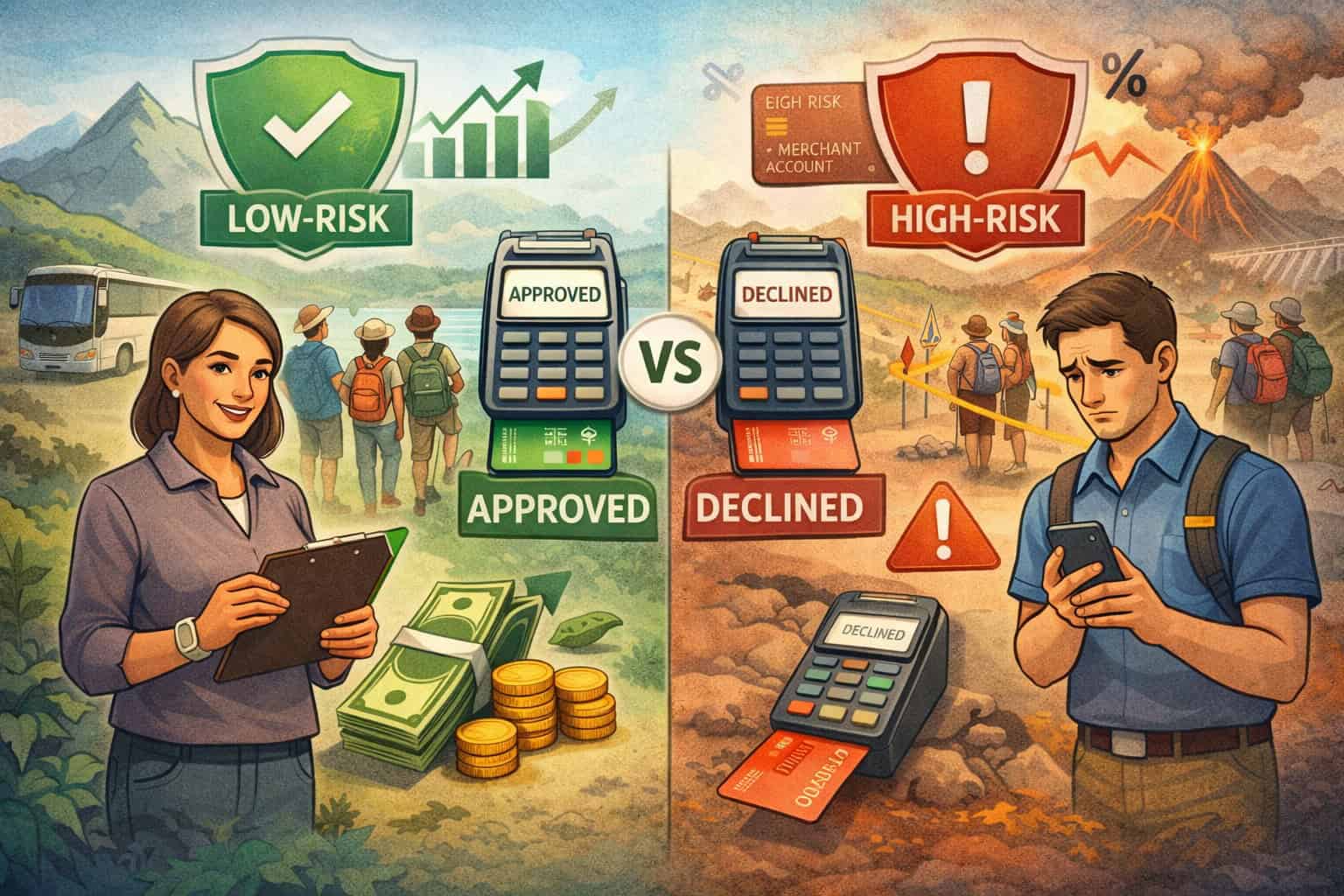
For tour operators, payment processing is not just a back-office detail. It shapes cash flow, affects approval rates, influences customer trust, and can determine whether a business can scale smoothly or gets stuck dealing with holds, reserves, and account reviews.
That is why understanding high-risk vs low-risk merchant accounts for tour operators matters so much. Two tour companies may sell memorable travel experiences, yet one may qualify for a standard merchant account while the other is pushed into a high-risk payment setup with stricter underwriting and higher costs.
The difference often comes down to how processors view timing, customer behavior, cancellations, pricing, and dispute exposure.
Many operators assume risk labels are only about fraud or bad business practices. In reality, risk classification is often about business model structure.
If you accept payment months before service delivery, sell expensive packages, serve international travelers, or face seasonal revenue swings, processors may see those factors as risk signals even if your operation is well run.
This guide explains what merchant accounts are, how risk classification works, why tour operators are often reviewed differently, and how to choose the right setup for your business.
Whether you run local day tours, guided adventure trips, multi-day experiences, or online travel bookings, the goal is the same: build a payment system that supports growth without creating unnecessary friction.
What a Merchant Account Is and Why Tour Operators Need One

A merchant account is a special type of business account that allows you to accept card payments. When a customer pays by credit or debit card, the transaction does not move directly from the customer’s bank into your regular business checking account.
Instead, it flows through a payment system that includes the gateway, processor, card networks, acquiring bank, and merchant account.
For tour operators, this setup matters because travel payments are rarely simple. A customer may place a deposit today, pay the balance later, request a date change, cancel a reservation, dispute a charge, or book from another country using a card issued abroad. Your payment setup has to support all of that while keeping approval rates strong and losses low.
A merchant account also affects how quickly you receive funds, what fees you pay, whether reserves are required, and how much flexibility you have with your checkout process. In other words, it is not just about accepting cards.
It is about controlling payment risk in a business category where customer expectations and processor expectations do not always line up.
Tour operators often need more guidance than other businesses because travel-related transactions carry extra moving parts. Payment timing is separated from service delivery. Refund policies can be complex. Supplier relationships may affect liability. Disputes can happen long after a booking is made.
That is why many operators benefit from studying broader travel payment topics such as payment processing for travel businesses and how travel-specific checkout flows work. A generic retail setup may technically accept payments, but that does not mean it is built for tours.
How Merchant Accounts Fit Into Tour Booking Payment Processing
When a traveler books a tour, the payment flow may include more than one stage. Some operators collect a full prepayment. Others take a deposit upfront and charge the remainder closer to departure. Some businesses process add-ons, equipment rentals, tips, or private upgrades after the original booking.
That means your merchant account has to support your actual sales process, not just the initial charge. If your provider struggles with delayed captures, split payments, recurring balance collection, or high-ticket authorizations, you may end up with operational headaches that spill into customer service.
Tour booking payment processing also depends on how you sell. A local walking tour with same-week bookings looks different from a guided expedition sold six months in advance. One may look closer to a standard service business, while the other may look more like a travel merchant with elevated exposure to disputes and non-delivery risk.
Processors pay close attention to this gap between payment date and service date. The longer the delay, the more concerned they become about cancellations, business interruptions, and future chargebacks. This is one of the main reasons travel businesses receive more underwriting scrutiny.
Why Generic Payment Advice Often Fails for Travel Businesses
A lot of merchant account advice online is written with retail stores, restaurants, or general ecommerce sellers in mind. That advice can be misleading for tour operators because it ignores the payment realities of travel-related services.
For example, a standard ecommerce store usually ships quickly after payment. A tour operator may not deliver service until weeks or months later.
A retail merchant can often resolve complaints with a replacement or exchange. A tour company may face weather issues, itinerary changes, or traveler misunderstandings that create refund disputes instead.
Travel businesses also deal with larger average tickets, nonrefundable deposits, group bookings, and international cardholders more often than ordinary local service companies. These factors change how processors evaluate the account and what underwriting terms they offer.
So while the technical building blocks may be similar, travel business merchant services need more careful matching. The wrong provider can create avoidable problems, even for a strong operator with excellent customer reviews and a legitimate business model.
What Low-Risk and High-Risk Merchant Accounts Mean

Low-risk and high-risk merchant accounts are underwriting categories used by processors and acquiring banks. These labels help them estimate how likely a merchant is to generate chargebacks, fraud losses, refund pressure, sudden volume spikes, or business failure before services are delivered.
A low-risk merchant account is generally offered to businesses with stable sales patterns, lower dispute risk, faster service fulfillment, and fewer warning signs in the underwriting review. A high-risk merchant account is used for businesses that present more uncertainty, more delayed fulfillment, or a greater chance of payment problems.
It is important to understand that high-risk does not mean illegitimate. Many perfectly legitimate travel companies are considered high-risk simply because of how their sales cycle works. Long booking windows, expensive packages, international customers, and cancellation exposure can all push an account into the high-risk category.
For tour operators, the classification often depends less on what you sell and more on how you sell it. A business offering local sightseeing tours booked a day or two in advance may fit a lower-risk profile. A company selling overseas adventure packages with large upfront deposits and seasonal volume swings may be classified very differently.
This is why merchant account risk classification explained in practical terms is so important. The label shapes your fees, reserve requirements, approval timeline, and provider options. It may also affect your ability to keep the same processor as your business evolves.
What a Low-Risk Merchant Account Usually Looks Like
A low-risk merchant account usually comes with simpler onboarding, fewer underwriting hurdles, and more favorable pricing. Providers are more comfortable offering faster approval and fewer restrictions when they believe the merchant presents predictable transaction behavior.
For a tour operator, low-risk status often depends on a combination of factors. These may include lower average ticket size, short booking windows, strong refund transparency, low chargeback history, domestic customer concentration, and a business model that does not rely heavily on advance payments months before service.
Operators that offer same-day or short-notice tours sometimes fit this profile more easily. So do businesses with clean financials, a long operating history, strong customer reviews, and clear terms posted on their website. In some cases, even a travel-related merchant can secure a standard account if the processor believes the overall risk is manageable.
That said, low-risk does not mean risk-free. A processor may still monitor volume changes, refunds, and disputes. Approval is not permanent immunity. It is simply a sign that the provider currently sees the account as more stable and predictable.
What a High-Risk Merchant Account Usually Looks Like
A high-risk merchant account is designed for merchants that banks and processors believe need tighter controls. The provider may still approve the business, but it will usually price for added uncertainty and build in protections such as reserves, delayed funding, or stricter monitoring.
For tour businesses, a high-risk merchant account for travel businesses is common when bookings are made far in advance, packages are expensive, services involve multiple suppliers, or a large share of customers are located outside the merchant’s home market.
Even a strong operator may be placed in this category if the business model creates delayed fulfillment exposure.
High-risk accounts often involve more documentation during underwriting. Providers may ask for bank statements, processing history, cancellation policies, supplier agreements, financial statements, and evidence of how customer disputes are handled. They want proof that the business is real, financially stable, and operationally prepared.
These accounts can still be a smart choice. In fact, for some operators, a specialist high-risk provider is far better than forcing a poor fit with a standard processor that may later freeze funds or terminate the account. The goal is not to avoid the label at all costs. The goal is to secure the right processing environment.
Why Tour Operators Are Often Viewed Differently by Payment Processors

Tour operators are often treated differently because processors do not only look at the transaction itself. They look at what could happen after the transaction. In travel, a lot can change between the booking date and the service date.
A customer may book months in advance, change travel plans, misunderstand the itinerary, cancel because of weather concerns, or dispute the charge after forgetting what they agreed to. From the processor’s point of view, that creates a wider window for complaints, refunds, and chargebacks than a typical point-of-sale transaction.
Travel businesses also deal with emotional purchases. When people spend meaningful amounts on leisure experiences, they may have stronger expectations and lower tolerance for inconvenience. A small misunderstanding can turn into a dispute if communication is unclear or if the merchant does not respond quickly.
Another reason tour operators receive special scrutiny is that payment issues in travel often involve more than one party. You may depend on guides, transportation providers, accommodations, or third-party booking platforms. If something breaks in the chain, the customer usually disputes the charge with the merchant whose name appears on the card statement.
This is why tour operator payment processing solutions need to account for more than checkout technology. They need to account for service timing, cancellation risk, chargeback defense, and booking clarity.
Advance Bookings and Delayed Fulfillment Raise Risk
One of the biggest factors in travel risk classification is the gap between payment and fulfillment. If a traveler pays today for a tour next season, the processor is exposed to a future performance risk that does not exist in many other industries.
During that waiting period, many things can happen. The customer may cancel. The business may change its itinerary. External conditions may affect travel plans. The longer the time gap, the higher the perceived exposure from an underwriting perspective.
Processors worry because chargebacks often arise when a customer feels the service delivered was not what was expected or when the service was not delivered at all. With delayed fulfillment, there is simply more time for something to go wrong.
Tour businesses with shorter lead times often have an easier path to standard processing. Those with long lead times may still be approved, but they are more likely to face high-risk pricing, reserve requirements, or extra scrutiny.
Cancellations, Refunds, and Chargebacks Matter More in Travel
Cancellations are normal in tourism, but processors watch them closely because refund-heavy businesses can create financial instability. If a merchant takes a lot of payments and then has to return a large percentage of them, that can signal operational weakness or poor customer alignment.
Chargebacks are an even bigger issue. In travel, disputes often come from misunderstanding rather than outright fraud. A guest may forget agreeing to a nonrefundable deposit, believe a tour was misrepresented, or contact the bank first instead of the merchant.
That is why policies and communication matter so much. Clear booking pages, visible cancellation terms, and timely post-booking confirmation emails can reduce confusion before it becomes a dispute. Resources like travel agency chargeback prevention are useful because they show how policy clarity directly affects dispute outcomes.
Processors look at both actual chargeback history and the likelihood of future disputes. Even a new operator with no prior processing record may be viewed as higher risk if the business model suggests refund or dispute pressure.
International Customers, High Ticket Sizes, and Seasonality Add Complexity
Many tour operators attract international customers, and that adds several layers of complexity. Cross-border transactions may have lower approval rates, higher fraud screening needs, currency conversion issues, and more opportunities for customer confusion.
High ticket sizes also matter. A large tour package creates more financial exposure per transaction than a lower-cost local activity. If a dispute occurs, the processor faces a bigger potential loss. That is why higher average ticket amounts often lead to tighter underwriting.
Seasonality is another factor. A business that earns most of its revenue in a short period may look unstable if the processor does not fully understand the seasonal cycle. Large spikes followed by quiet periods can trigger reviews, especially if the volume differs sharply from the original application profile.
None of these factors automatically mean a tour operator is problematic. They simply explain why high-risk payment processing for tours is common and why travel merchants need providers that understand their sales patterns instead of treating them like ordinary retail businesses.
Merchant Account Risk Classification Explained in Practical Terms
Risk classification sounds technical, but the concept is simple. A processor is trying to answer one basic question: how likely is it that this merchant will create losses or operational headaches after card payments are accepted?
To answer that question, the processor looks at the business from several angles. They review what the company sells, when it delivers service, how customers are billed, whether disputes are common in the category, and how strong the business appears financially. They also study the merchant’s website, policies, financial documents, and prior processing history.
For tour operators, classification is not usually based on one single factor. It is based on a pattern. A business with long lead times, expensive bookings, aggressive cancellation terms, international cardholders, and little processing history may trigger several concerns at once.
Another business with local customers, short booking windows, low average tickets, and strong documentation may look much safer.
The key point is that processors use classification to decide how to price and manage the account. They may offer a standard merchant account, refer the business to a travel-specialist provider, impose reserves, or request updated documents over time.
The Main Factors Underwriters Review
Underwriters usually focus on patterns that predict future problems. They want to see whether the merchant is likely to deliver services successfully and handle customer issues without pushing them back onto the processor.
Common review areas include:
- Time between booking and tour date
- Average transaction size
- Monthly processing volume
- Refund and cancellation rates
- Prior chargeback history
- Customer location mix
- Card-present versus card-not-present volume
- Business age and ownership structure
- Website quality and booking transparency
- Financial strength and liquidity
For a travel-related business, these factors matter together. A high average ticket may be acceptable if the chargeback history is low and the operator has years of stable performance. A short operating history may be acceptable if booking windows are short and the business model is simple.
What underwriters want most is predictability. If they can see how your business works and why the payment flow makes sense, approval usually becomes easier.
Why the Same Tour Business Can Be Classified Differently by Different Providers
Merchant account risk assessment is not completely uniform. Two providers can look at the same tour operator and reach different conclusions based on their bank partners, underwriting appetite, and experience with the travel sector.
A standard processor may see advance bookings and decline the application immediately. A travel-focused provider may understand that the operator has strong cancellation controls, low historical disputes, and a documented fulfillment process. The business model did not change, but the interpretation did.
This is one reason many tour operators get confused. They may be told by one company that they are too risky, then receive approval elsewhere under workable terms. The difference often comes down to how familiar the provider is with travel.
That is why researching travel industry merchant account providers matters. A good fit is not simply about whether a company can process cards. It is about whether it can underwrite your business accurately and support your actual operating model.
Low-Risk Merchant Account Requirements for Tour Operators
Many operators want to know exactly what improves their odds of qualifying for a standard account. While there is no universal checklist, there are common low-risk merchant account requirements that help a tour business look more stable in the eyes of underwriters.
First, processors want to see a legitimate, transparent business. Your website should clearly explain what you offer, what customers are buying, when tours take place, what is included, how cancellations work, and how customers can contact you. Hidden terms or vague descriptions are red flags.
Second, underwriters want to see that customers are unlikely to feel surprised after purchase. Transparent pricing, clear refund policies, visible contact details, and accurate checkout descriptors all reduce the chance of disputes. If the business looks organized and easy to reach, that improves confidence.
Third, financial stability matters. A processor wants to know that you can keep operating even if there is a wave of refunds or a temporary slowdown. Strong bank balances, a reasonable operating history, and consistent sales patterns all help.
For some tour operators, qualifying as low-risk may not be realistic right away. But many of these same factors still improve approval terms even if the business remains in a travel-related high-risk category.
Website, Policies, and Customer Experience Signals
Your website often acts as the first underwriting document. Before a provider reviews your bank statements or processing history, they may look at your site to see how clearly the business presents itself.
Important signals include a detailed services page, an obvious refund and cancellation policy, terms and conditions, privacy policy, customer support information, and transparent pricing. If the booking flow looks confusing or incomplete, the processor may assume customers will be confused too.
It also helps when customers receive immediate booking confirmations and can easily recognize the business name that will appear on their card statement. Confusion at this stage often leads to “friendly fraud” disputes, where the cardholder claims not to recognize the charge.
A well-structured booking process shows that your business is serious and organized. For underwriters, that can be just as important as financial data.
Processing History, Financial Strength, and Business Stability
If you already process card payments, your prior history can be one of the most valuable parts of the application. Low chargeback rates, manageable refund levels, and stable volume make a strong impression.
Newer businesses can still be approved, but they may need to compensate with stronger documentation. This can include owner experience, healthy bank balances, supplier contracts, and a realistic revenue profile. Underwriters want to believe the business can fulfill bookings and weather normal disruptions.
Business stability also includes operational consistency. Sudden unexplained volume spikes, unclear revenue sources, or aggressive projections may create concerns. Processors usually prefer merchants who present realistic numbers and stay within expected patterns.
For operators trying to move from a stricter risk profile toward better terms, a clean track record over time is one of the most powerful assets they can build.
High-Risk Merchant Account for Travel Businesses Explained
A high-risk merchant account for travel businesses is a payment setup designed for categories where card processors expect elevated exposure to chargebacks, cancellations, delayed service delivery, or fraud. In the travel world, that often includes tour operators, travel agencies, booking platforms, and multi-supplier businesses.
These accounts are not a punishment. They are a risk management structure. The provider may allow the business to process card payments, but it protects itself with higher pricing, more documentation, reserve requirements, or stricter account monitoring.
For many tour operators, a high-risk account is actually the more stable choice. Instead of trying to squeeze into a standard processor that does not understand travel, the merchant works with a provider that expects these patterns and prices for them upfront. That can lead to fewer surprises later.
The tradeoff is cost and complexity. High-risk accounts usually involve more underwriting, more contract review, and closer monitoring. But if your business model includes long lead times, group tours, expensive packages, or international bookings, this structure may be a better operational fit.
Common Features of High-Risk Payment Processing for Tours
High-risk travel processing often includes several features designed to reduce provider exposure. These may include rolling reserves, delayed funding, volume caps, or enhanced fraud monitoring.
A rolling reserve means the processor holds back a percentage of each batch for a set period. This reserve acts like a safety cushion in case chargebacks or refunds arise later. While frustrating from a cash-flow perspective, it is common in travel because of the delayed service model.
Funding may also take longer. Instead of receiving funds immediately, the merchant may wait several business days or longer depending on the provider’s risk structure. Contract terms may be stricter as well, especially for merchants with limited history.
The most important point is fit. A specialist in high-risk payment processing for tours is usually better equipped to handle travel realities such as advance bookings, itinerary changes, and dispute-heavy customer behavior.
When a High-Risk Setup Is the Better Choice
A high-risk provider is often the better choice when your business model already aligns with risk factors that standard processors dislike. This includes multi-day travel packages, international customers, higher average booking values, long booking windows, or previous account terminations.
It can also be the better route if your business has grown beyond the limits of a basic payment platform. Some operators start with a simple provider, then run into problems as transaction size, volume, or travel complexity increases. At that point, a specialist account may provide better long-term stability.
Another strong reason to choose a high-risk setup is honesty. If your business clearly fits a higher-risk profile, presenting it accurately to the right provider is safer than trying to downplay the reality. The wrong fit can lead to frozen funds, sudden holds, or account closure at the worst possible time.
A provider that understands travel risk is more likely to ask the right questions, set realistic terms, and support your business as it grows.
Low-Risk vs. High-Risk Merchant Accounts: Side-by-Side Comparison
The difference between low-risk and high-risk accounts becomes clearer when you compare the terms side by side. While every provider has its own rules, certain patterns are common across the market.
| Factor | Low-Risk Merchant Account | High-Risk Merchant Account |
| Approval process | Faster and simpler | Slower and more document-heavy |
| Underwriting depth | Basic to moderate | Moderate to extensive |
| Typical pricing | Lower rates and fewer added fees | Higher rates and more risk-related fees |
| Reserve requirement | Rare or limited | More common |
| Rolling reserve | Usually not required | Often required |
| Funding speed | Faster | May be delayed |
| Contract terms | More flexible in many cases | Often stricter |
| Volume tolerance | Standard patterns expected | More monitoring of spikes and seasonality |
| Chargeback tolerance | Lower tolerance for problem trends | Built to handle elevated dispute environments |
| Best fit | Stable, predictable merchants | Travel and other elevated-risk business models |
For tour operators, this table is useful because it shows why the “cheapest” option is not always the right one. A low-risk provider may look attractive initially, but if the account is not built for your booking model, the long-term cost can be much higher through holds, instability, and time-consuming reviews.
Differences in Underwriting, Fees, and Contract Terms
Underwriting is usually the biggest operational difference. Low-risk providers often want to confirm business basics and recent processing activity. High-risk providers usually want a much fuller picture, including fulfillment timing, cancellation practices, and financial resilience.
Fees also differ. A high-risk account often comes with higher transaction pricing, monthly fees, chargeback fees, and possibly gateway or monitoring costs. Those costs reflect the provider’s view of category exposure, not necessarily poor merchant quality.
Contract terms may be longer or more structured in high-risk accounts. Some merchants dislike that, but it can be part of securing a stable travel-processing relationship. Review the details carefully, especially around termination, reserve release timing, and funding schedules.
Differences in Reserves, Approval Speed, and Ongoing Monitoring
Reserves are one of the most important differences for tour businesses because they affect cash flow directly. A low-risk merchant may receive funds quickly with little or no holdback. A high-risk merchant may have a portion of sales held in reserve for weeks or months.
Approval speed also changes significantly. Standard accounts may be approved quickly if the business looks simple and familiar. High-risk travel accounts often take longer because the provider needs to understand booking timing, refund risk, and operational controls.
Ongoing monitoring is another important difference. High-risk accounts are more likely to face regular reviews of volume, chargeback ratio, refund behavior, and ticket size. Merchants should not view this as unusual. In travel, monitoring is part of the relationship.
How Payment Processors Evaluate Tour Businesses
When processors evaluate a tour business, they are looking for risk signals, but they are also looking for evidence of control. They want to see whether the operator understands its own payment flow and has systems in place to reduce disputes and service problems.
Most reviews begin with business basics: company structure, ownership, website, and expected processing volume. Then the underwriter typically moves deeper into operating details such as average ticket size, time from booking to fulfillment, refund policy, and customer geography.
They also study whether the merchant’s story makes sense. If your website shows low-cost local tours but your application lists very high average transaction values, that inconsistency may trigger questions. If your cancellation terms are strict but there is no visible policy page, that raises another concern.
Processors also care about how the merchant plans to accept payments. Online-only bookings usually receive more scrutiny than in-person transactions because card-not-present risk is generally higher. Phone payments, recurring balance collection, and deposits can also affect the risk profile.
Documents and Business Details Underwriters Usually Review
Tour operators should expect underwriters to request documentation that proves the business is real, financially viable, and operationally prepared. The exact list varies, but common requests include:
- Business license or formation documents
- Government-issued identification for owners
- Recent business bank statements
- Prior merchant processing statements
- Void check or bank verification
- Financial statements
- Website URL and policy pages
- Sample invoices or itineraries
- Supplier or vendor agreements
- Marketing materials or booking terms
For higher-risk travel businesses, the provider may also ask about chargeback procedures, delivery timelines, reserve capacity, or how customer funds are handled before the trip occurs. These questions are normal and should be answered clearly.
The more organized your documentation is, the smoother the underwriting process tends to be.
What Underwriters Want to Feel Confident About
At a practical level, underwriters want confidence in five things: the business is legitimate, the service will likely be delivered, customers know what they are buying, the merchant can handle refunds or disputes, and the provider will not be left covering major losses.
Tour operators can support that confidence by documenting how bookings work from start to finish. Show when customers pay, what they receive immediately, how reminders are sent, how policy acceptance is captured, and what happens if plans change.
Underwriters also want honesty. Do not understate booking windows, average ticket size, or customer geography. A realistic application is far more likely to lead to a stable approval than an optimistic one that later triggers account reviews.
If you explain your model clearly and back it up with documents, you make the underwriter’s job easier. That usually works in your favor.
Tour Operator Payment Processing Solutions for Different Business Models
Not all tour operators need the same payment setup. A walking tour company with small same-week bookings does not need the same structure as a luxury adventure operator collecting large deposits months in advance. That is why tour operator payment processing solutions should be matched to the business model, not treated as one-size-fits-all.
The strongest setup is the one that aligns processor expectations with real operating conditions. If the payment flow, refund logic, and booking timeline match what the provider underwrote, the relationship is usually more stable.
Operators should think beyond “can this platform take cards?” and focus instead on whether the system supports deposits, balance collection, modifications, refunds, clear descriptors, dispute evidence, fraud screening, and international card acceptance if needed.
Local Tour Operators and Short-Lead Booking Businesses
Local operators often have an advantage in underwriting because the time between payment and fulfillment is shorter. City tours, museum experiences, food tours, and local excursions may look closer to standard service merchants if the average ticket is modest and disputes are low.
These businesses often benefit from payment setups that prioritize quick checkout, mobile optimization, easy refunds, and strong booking confirmations. If most customers book shortly before the tour date, the processor may view the risk as more manageable.
That said, local operators still need good documentation. Card-not-present sales, unclear cancellation policies, and confusing descriptors can still create chargeback problems even in a lower-risk model.
Adventure Tour Companies, Multi-Day Trips, and Online Booking Operators
Adventure operators and multi-day travel businesses usually face more underwriting scrutiny because the service is more complex and the customer commitment is larger. These businesses often require deposits, higher tickets, longer lead times, and detailed cancellation structures.
Online booking operators also face extra review when they aggregate multiple offerings or act as an intermediary between traveler and supplier. In these models, liability and customer expectation can become less clear, which processors dislike.
That is why operators in this category should pay close attention to gateway quality and dispute readiness. Content such as secure payment processing for online travel agencies and optimizing payment gateways for international travel bookings can help clarify what a more advanced travel payments setup should support.
These businesses may need specialist underwriting from the beginning. That is often the safer route.
How to Improve Approval Chances and Reduce Perceived Risk
Tour operators cannot change the nature of travel, but they can absolutely improve how their business looks during underwriting. Reducing perceived risk is often about removing uncertainty and showing operational discipline.
Start by making your website underwriter-friendly. Include complete tour descriptions, pricing transparency, refund and cancellation terms, support information, and clear delivery expectations. If customers can understand your business quickly, underwriters can too.
Next, document your booking and service process. Show what happens after purchase, how confirmations are sent, when reminders go out, and how customers can contact support. If you use deposits, explain how balance payments are collected and disclosed.
Keep your financial records clean and your application realistic. Do not overstate volume, understate ticket size, or leave gaps in ownership information. Providers are more comfortable with a modest but believable application than one that looks polished but inconsistent.
Ways to Look Stronger to Underwriters
There are several practical steps that can improve your approval odds or lead to better terms:
- Keep chargebacks and refunds as low as reasonably possible
- Use clear billing descriptors customers will recognize
- Capture policy acceptance during checkout
- Send prompt booking confirmations and reminders
- Make support contact information easy to find
- Maintain healthy business bank balances
- Prepare organized documentation in advance
- Be honest about booking windows and ticket size
- Avoid sudden unexplained processing spikes
- Show prior processing history if it is clean
These actions do not guarantee a low-risk classification, but they make the business easier to trust. That can influence reserve terms, funding speed, and underwriting comfort.
Common Mistakes Tour Operators Make When Applying
One of the most common mistakes is applying with a provider that clearly does not support travel risk well. Another is assuming a generic platform will automatically scale with the business as ticket size and booking complexity increase.
Other frequent mistakes include weak or missing website policies, inaccurate projections, unclear ownership details, and failure to disclose long advance-booking cycles. Some operators also use vague descriptors that customers do not recognize later on their card statements.
Another problem is treating chargebacks as just a customer service annoyance. Underwriters view dispute history as a major risk signal. If your business has recurring friendly fraud or misunderstanding issues, address the root cause before applying for better terms.
How to Choose Between a Standard Provider and a High-Risk Provider
Choosing between a standard processor and a high-risk provider comes down to business fit, not pride. The right question is not “Can I get approved somewhere?” The right question is “Which provider type is most likely to support my business model without painful surprises?”
A standard provider may work well if your tours are low-ticket, fulfilled quickly, primarily domestic, and supported by a clean processing history. If your model is simple and predictable, a traditional merchant setup may be enough.
A high-risk provider is usually the smarter choice if your bookings are made far ahead of travel, your average ticket is high, your customer base is international, your refund exposure is significant, or you have had past processing issues. In those cases, specialist underwriting usually offers more stability.
It is also possible to outgrow one category and move toward another over time. A tour operator might begin with a stricter setup, then negotiate better terms later after building a strong payments record. That is a much better outcome than being shut down by a poor-fit processor at a critical time.
What to Look for in Travel Industry Merchant Account Providers
The best travel industry merchant account providers are not just payment companies with a travel page on their website. They understand how bookings, cancellations, disputes, and delayed fulfillment work in real travel operations.
Look for providers that can explain how they handle reserves, funding schedules, refund timelines, chargeback support, and international cards. Ask whether they support deposits, delayed captures, recurring balance collection, and booking platform integrations if relevant.
Also pay attention to transparency. You want clear answers on pricing, contract length, reserve release timing, and what happens if volume changes seasonally. A vague sales promise is not enough.
Good travel business merchant services should reduce uncertainty, not create it.
Questions to Ask Before You Sign
Before choosing a provider, ask practical questions such as:
- Do you support tour and travel-related merchants directly?
- What reserve structure, if any, do you require?
- How quickly are funds settled?
- What documents do you need for underwriting?
- How do you handle chargeback support?
- Can the account support deposits and balance payments?
- What happens if seasonal volume spikes?
- Are international cards and currencies supported?
- What are the termination terms?
- Can rates or reserve terms improve over time?
These questions help you compare providers based on long-term fit, not just the initial sales pitch.
Tips for Reducing Chargebacks and Building a Stronger Payment Profile
A stronger payment profile is built over time through cleaner operations, clearer communication, and better dispute prevention. Tour operators that manage this well often gain access to better processing relationships, lower reserves, or more favorable pricing.
The first priority is preventing customer confusion. Travelers should know exactly what they booked, what is included, what is excluded, when the tour takes place, and what the cancellation rules are. Booking confirmations should repeat the key details clearly.
The second priority is making legitimate customer support easy. Many chargebacks happen because the cardholder cannot quickly reach the merchant or assumes the bank is the fastest route. Fast, visible support can stop many disputes before they start.
Third, keep excellent records. Save signed waivers, booking confirmations, policy acceptance logs, communication history, itinerary changes, and proof of service delivery. If a dispute arises, this documentation matters.
Resources like how to fight travel chargebacks can help operators think more strategically about evidence and dispute readiness. Chargeback management is not just reactive. It should shape how your booking flow is built from the start.
Practical Chargeback Reduction Tactics for Tour Operators
To reduce disputes, focus on the moments where misunderstanding usually begins:
- Use a billing descriptor that matches your brand name clearly
- Display cancellation and refund terms before payment
- Require checkbox acceptance for terms
- Send detailed confirmation emails immediately
- Send reminder emails before the tour date
- Make itinerary changes easy to document
- Offer support channels that respond quickly
- Issue refunds promptly when your policy allows
- Keep screenshots or logs of policy acceptance
- Train staff to document customer communication carefully
These steps improve customer clarity and strengthen your evidence if a dispute occurs later.
How Stronger Operations Can Improve Merchant Account Terms Over Time
Processors often reward merchants that show stability. If your dispute ratio remains low, refunds stay manageable, and volume stays within expected patterns, you may be able to request better pricing or reduced reserve requirements later.
This improvement usually takes time. Providers want to see sustained evidence, not one good month. But for tour operators, that long-term payoff can be significant. Better terms improve cash flow and reduce friction across the business.
The key is consistency. Build a booking and support process that makes disputes less likely, then let clean performance speak for itself.
Frequently Asked Questions
Here are some common questions tour operators ask when comparing low-risk and high-risk merchant accounts, approval standards, reserves, and payment setup options.
Can a tour operator start with a low-risk account and switch later?
Yes, that can happen if the business model changes or if the operator builds a strong record over time. Some businesses begin with a stricter setup because they are new, have limited history, or take bookings far in advance. After demonstrating stable volume, low disputes, and healthy financials, they may qualify for better terms later. The reverse can also happen if the business grows more complex and outpaces a standard provider.
Does being labeled high-risk mean a tour company did something wrong?
No. In travel, high-risk often reflects the structure of the business rather than bad behavior. Long lead times, large ticket sizes, cross-border customers, and cancellations can all increase perceived processor exposure. A legitimate, well-run operator can still be categorized as high-risk simply because the payment environment is more complex.
Are reserves always required for high-risk travel merchant accounts?
Not always, but they are common. Some providers require rolling reserves from the start, while others may offer lower or no reserve requirements if the merchant has strong processing history, healthy financials, and a lower-risk operating model within the travel category. Reserve terms are negotiated through underwriting, not assumed automatically.
What is the biggest reason tour operators get declined?
A mismatch between the business model and the provider is one of the biggest reasons. Other common reasons include incomplete website policies, poor or missing documentation, high prior chargeback ratios, unrealistic revenue projections, and insufficient financial strength for advance-booking exposure. Declines often say more about provider fit than merchant legitimacy.
Do local day-tour operators always qualify as low-risk?
No. They may have an easier path than multi-day or international operators, but classification still depends on the whole picture. If the business has weak policies, confusing descriptors, poor chargeback history, or heavy online card-not-present volume, it can still be viewed as elevated risk. Shorter booking windows help, but they do not decide everything on their own.
What payment features matter most for tour booking processing?
The most useful features usually include deposit support, balance collection, refund tools, booking confirmations, clear billing descriptors, chargeback evidence support, fraud screening, and integration with the booking system. For operators with international demand, cross-border card acceptance and gateway flexibility also matter. The right features depend on how the tour business actually sells.
Should a tour operator choose the cheapest processing rate available?
Usually not. A low headline rate means little if the provider is a poor match and later freezes funds, imposes sudden holds, or closes the account. Tour operators should evaluate total fit, including underwriting comfort, reserve structure, chargeback support, and booking-model compatibility. Stability often creates more value than a small pricing difference.
Conclusion
Understanding high-risk vs low-risk merchant accounts for tour operators is really about understanding how processors see travel-related risk. The label affects underwriting, fees, reserves, funding speed, and account stability, but it does not define the quality of your business.
For tour operators, risk classification is often driven by practical realities: advance bookings, cancellations, higher ticket values, seasonal demand, international travelers, and the gap between payment and service delivery. Those factors can push an otherwise excellent operator into a high-risk category, especially when working with providers that do not specialize in travel.
The right move is not to chase the lowest rate or the easiest signup. It is to choose a payment setup that matches your business model, supports your booking flow, and gives you room to build a stronger merchant profile over time.
When you combine clear policies, organized documentation, better chargeback prevention, and the right provider fit, payment processing becomes less of a risk point and more of a growth tool.
For a tour business, that is the real goal: not just getting approved, but building a stable payment foundation that supports the customer experience and the business behind it.