Travel chargebacks are one of the most expensive “silent leaks” in lodging revenue. They don’t just reverse room revenue—you also lose interchange/processing costs, pay dispute fees, risk higher fraud monitoring thresholds, and spend staff time chasing documents.
Worse, travel chargebacks often spike after peak seasons, weather disruptions, large events, and policy changes, which makes forecasting and cash flow harder for owners and revenue managers.
From an operator’s perspective, the good news is this: most travel chargebacks are preventable, and many are winnable—if you build a repeatable workflow that ties together reservations, payments, guest messaging, and evidence packaging.
Card networks publish detailed dispute guidance for merchants, and your ability to fight travel chargebacks depends on how well you align with those rules and timelines. Visa’s dispute management guidance and Mastercard’s chargeback guide are the backbone references most acquirers follow.
This guide is written for hotel GMs, controllers, front office leaders, and revenue teams who need an end-to-end playbook: prevention, response, representation, and long-term chargeback reduction—without drowning in paperwork.
You’ll also get practical examples (no-show disputes, resort fee complaints, OTA confusion, “card not present” fraud), terminology used by issuers and acquirers, and future-focused recommendations as dispute automation keeps evolving.
Understand Why Travel Chargebacks Happen in Lodging
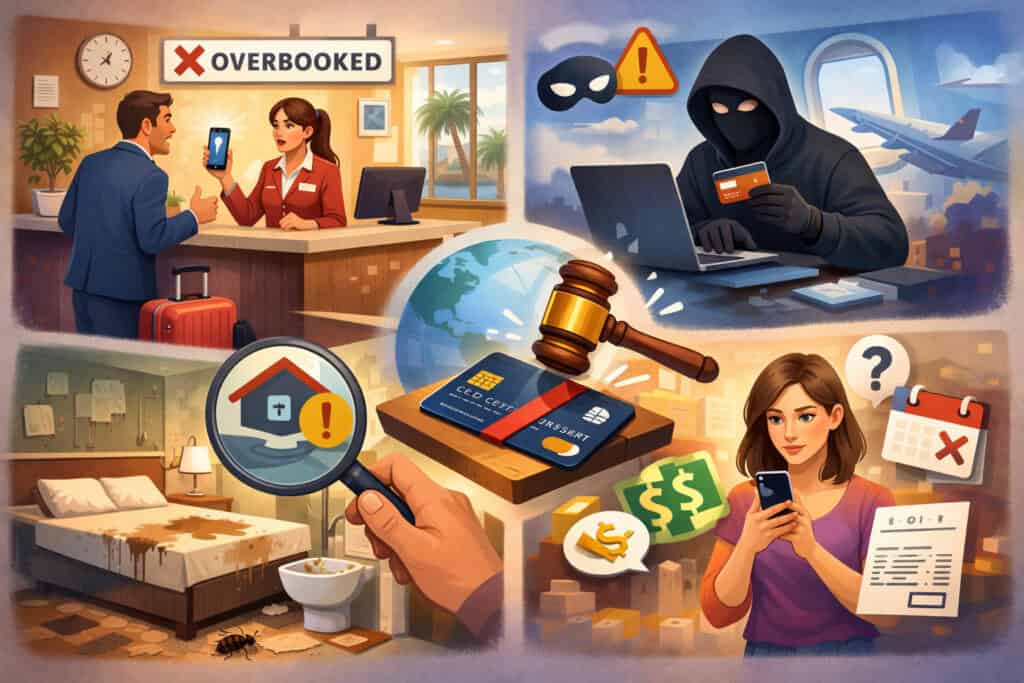
To fight travel chargebacks, you have to think like an issuer analyst reviewing a case in minutes, not like a hotel team that lived the full guest story for weeks. Issuers bucket disputes into a few recurring themes: fraud/unauthorized use, services not received, not as described, cancellation/refund issues, and processing errors.
Lodging is uniquely vulnerable because the stay happens later (advance purchase), policies vary by rate plan, and a reservation can be modified multiple times—often through third parties.
In travel chargebacks, the “truth” of what happened matters less than what you can prove in a structured way. Networks and processors emphasize compelling evidence: documentation that links the cardholder, the reservation, the policy disclosure, and the service delivery.
Visa’s merchant dispute guidance is explicit that the goal is minimizing loss through accurate information, staff training, and proper back-office processes.
Common lodging-specific triggers include:
- No-show/late cancellation fees where the guest claims they canceled or never agreed to the policy.
- Deposit disputes tied to ambiguous refund windows or unclear “non-refundable” terms.
- Resort/amenity fees that guests claim were hidden or not disclosed upfront—especially important given recent fee transparency enforcement affecting short-term lodging advertising.
- OTA “I didn’t recognize this charge” where the descriptor is confusing or the guest believes they paid the OTA, not the property.
- Fraud on card-not-present reservations, especially with high-demand dates and same-day bookings.
- Late presentment/processing timing problems if you capture or clear outside allowed time frames (often tied to delayed folios, offline posting, or manual adjustments).
When you fight travel chargebacks, you’re not just arguing. You’re showing that your processes meet network rules, your disclosures were clear, and the guest received what they paid for.
The “Reason Code” mindset (and why hotels must map disputes correctly)
Every travel chargeback arrives with a reason code (or a mapped category), and that code determines what evidence wins.
Stripe’s dispute documentation summarizes network categories and the types of evidence that generally succeed, which mirrors what most acquirers coach. The mistake many hotels make is sending “everything we have” instead of sending the “right” documents for that category.
For example, a no-show dispute isn’t won with a generic reservation screenshot. It’s won by proving (1) the policy was disclosed and accepted, (2) the guest didn’t show within the defined window, and (3) the fee charged matches the policy.
Mastercard even has lodging-specific dispute handling, and industry guides highlight “no show hotel charge” patterns that require very specific documentation.
Treat reason codes like diagnosis codes in healthcare: if you don’t classify correctly, you’ll prescribe the wrong response. Your chargeback SOP should start with mapping each travel chargeback to a standard evidence checklist that your team can execute fast.
Step 1: Build a “Chargeback-Ready” Booking and Disclosure System
The cheapest travel chargeback to fight is the one that never happens. “Chargeback-ready” doesn’t mean being aggressive with guests—it means creating a reservation, disclosure, and confirmation trail that is clean enough to survive issuer scrutiny.
Your first defensive layer is policy clarity. Every rate plan should have: cancellation window, no-show fee, deposit rules, refund timelines, incidental/authorization language, and any mandatory fees.
Then that information must appear consistently across the booking path: brand site, confirmation email, pre-arrival messages, and (if applicable) OTA content you control.
Fee transparency is no longer “nice to have.” Regulatory enforcement on hidden or drip pricing in short-term lodging has increased the risk that unclear mandatory fees turn into disputes and complaints.
The FTC has publicly highlighted enforcement around deceptive pricing tactics and fee disclosure in lodging contexts, and legal analyses of the rule emphasize showing the total price with mandatory fees upfront.
From a travel chargeback standpoint, transparent fees reduce “not as described” and “unexpected charge” disputes.
Next is descriptor and receipt clarity. Many travel chargebacks begin with “I don’t recognize this merchant.” If your statement descriptor is a management company acronym, the guest may dispute before calling.
Align descriptor text with your property name and location when possible, and ensure your confirmation email includes:
- Property name as it appears on statements
- Contact phone number
- Reservation ID and dates
- Rate details and taxes/mandatory fees
- Cancellation terms and deadlines
Finally, tighten your payment flow. If you accept card-not-present payments, follow PCI DSS expectations for protecting card data and limiting exposure.
PCI DSS is the baseline standard for safeguarding account data, and the PCI Security Standards Council provides the official framework used across the card ecosystem. Cleaner data handling reduces fraud, which reduces travel chargebacks.
Make policy acceptance provable (not just “available somewhere”)
To fight travel chargebacks, you must prove the guest agreed to your terms. A policy link in a footer helps, but issuer analysts prefer evidence showing affirmative acceptance. For direct bookings, that could be:
- Checkbox acceptance (timestamp + IP + device)
- “By completing this booking you agree…” language directly above the pay button
- Confirmation email repeating the policy with the key dates (example: “Cancel by 4:00 PM local time on March 10 to avoid one-night fee.”)
For phone reservations, your proof must be operational: call recordings (where permitted), agent scripts, and confirmation emails sent immediately. If you can’t produce acceptance evidence, you may still win some cases, but your win rate will be inconsistent.
Also align on timelines: if you charge a no-show fee, ensure the charge date matches your written policy and that posting/capture timing follows network time frames.
Visa has documented changes and structure around authorization/clearing time frames that affect how long merchants have to complete and clear transactions. When your hotel posts late, you invite “late presentment” or processing disputes that are entirely avoidable.
Step 2: Prevent the Most Common Travel Chargebacks Before the Guest Arrives

Prevention is not a single control—it’s a chain. The best operators reduce travel chargebacks by combining fraud screening, expectation-setting, and proactive service recovery. This is where hotels outperform pure e-commerce merchants, because you have multiple touchpoints before the stay.
Start with fraud reduction on high-risk reservations:
- Same-day bookings with high ADR and one-night stays
- Multiple cards attempted
- Mismatched billing zip + phone
- Email domains that look auto-generated
- International IP with local arrival (or the reverse)
- Large incidentals authorization attempts after check-in
Work with your gateway or processor to implement velocity filters and AVS/CVV rules where appropriate (without creating excessive declines). Many travel chargebacks categorized as “fraud” are actually “friendly fraud” (guest disputes after a legitimate stay), but true fraud still exists and is costly.
Then fix expectation gaps that trigger “services not as described.” Hospitality disputes often stem from:
- Renovation noise
- Closed amenities
- Parking fees or resort/destination fees
- Pet fees, extra-person charges, early departure penalties
Proactive messaging reduces chargebacks: pre-arrival emails and SMS that restate fees and policies, and offer an easy way to change or cancel within policy windows. Clear communication is one of the simplest ways to fight travel chargebacks without fighting at all.
Finally, prioritize refund speed. Refund-related disputes (“credit not processed”) are common, and they become chargebacks when guests feel ignored.
Card networks and processors repeatedly emphasize responding with the right documents within required timeframes; American Express, for example, highlights a 20-day response window in its dispute materials. If your internal refund SLA is slower than guest patience, travel chargebacks will rise.
Use service recovery to stop “dispute intent” in real time
Your team should treat “I’m going to dispute this” as an urgent operational signal, not a customer-service annoyance. A guest who threatens a travel chargeback is telling you they’ve lost trust. The goal is to resolve the issue before they file.
Practical playbook:
- Empower front desk supervisors to issue partial refunds or credits within limits.
- Provide a single escalation inbox or phone extension for billing disputes.
- Respond within 24 hours with a written plan: “We reviewed folio #___, here is the breakdown, and here is what we are doing.”
Even when you believe the fee is valid, offer clarity: attach folio, highlight the policy, and show timestamps. Many guests don’t actually want conflict—they want to feel heard.
Also, be careful with fee disclosure. With fee transparency enforcement increasing in lodging advertising, unclear resort/service fee presentation can create more disputes. Staying ahead of that trend reduces travel chargebacks tied to “unexpected charges.”
Step 3: Triage Every Travel Chargeback Within 24 Hours
Once a travel chargeback hits, speed matters. Not because you can “talk the bank out of it,” but because evidence collection degrades quickly: staff turnover, camera footage retention, PMS log overwrites, and misplaced signed registrations.
Your triage process should answer five questions immediately:
- What is the dispute category/reason code?
- Is it fraud/unauthorized, or a service/policy dispute?
- What are the network deadlines for response and representation?
- Do we have the evidence to win?
- Should we fight, refund, or accept the cost of doing business?
Build a one-page decision matrix. Some travel chargebacks cost more to fight than to accept—especially low-dollar disputes with weak evidence. But avoid “auto-losing” patterns. If you always concede no-show disputes, you will train repeat abusers.
Your case file should be assembled the same way every time:
- Reservation confirmation + policy disclosure
- Folio showing charges (room, tax, fees, incidentals)
- Authorization logs (initial and incremental)
- Proof of stay (check-in timestamp, key encoding, ID verification per your policy)
- Guest communications (emails, SMS, chat transcripts)
- Refund records (if applicable)
Use consistent naming. Issuer analysts will not hunt through 40 pages. The easier you make it to see the story, the more you fight travel chargebacks successfully.
Also remember: consumer billing dispute rights exist under federal rules for credit billing error resolution (commonly referenced under Regulation Z). This shapes how issuers handle disputes and timelines from the consumer side.
Knowing this helps you understand why banks ask for specific documentation and why “we told them verbally” rarely wins.
Separate “fraud” from “friendly fraud” with operational signals
Not all fraud-coded travel chargebacks are true fraud. A classic lodging pattern:
- Guest stays
- Guest complains at checkout
- Hotel enforces policy or denies refund
- Guest disputes as “unauthorized”
If you can show proof of stay and identity verification steps consistent with your process, you can often overturn these. Signals that help:
- Matching guest name on reservation and ID captured at check-in (within your privacy and compliance rules)
- Keycard issuance logs
- Signed registration card acknowledging incidentals and fees
- Wi-Fi login record tied to room (where available and compliant)
Be careful not to overshare sensitive data. Keep evidence focused, redact where appropriate, and align with PCI DSS expectations around minimizing stored card data. PCI DSS is designed as a baseline to protect payment account data and reduce ecosystem risk.
This is how you fight travel chargebacks without creating new compliance problems.
Step 4: Build “Compelling Evidence” Packs That Win Lodging Disputes
Compelling evidence is not “more pages.” It’s the right pages, ordered logically, with clear labels, and tied directly to the claim.
A strong travel chargebacks evidence pack typically includes:
- Cover page summary (one paragraph): what the guest purchased, what policy applied, what was delivered, and why the charge is valid.
- Timeline with timestamps: booking → confirmation → pre-arrival → check-in → stay events → checkout → post-stay communications → refund/denial.
- Policy acceptance proof: screenshot of the booking flow, checkbox acceptance log, or confirmation email that repeats the policy.
- Proof of service: folio, stay dates, room assignment, key issuance logs.
- Refund documentation: if a refund was issued, show the refund receipt and processing date.
Network and processor materials emphasize providing the specific documents required to challenge each type of claim. For example, dispute platforms map reason categories to evidence types (like “proof of service,” “refund policy,” “customer communication”).
For “no-show” travel chargebacks, lodging disputes are often very documentation-heavy. Industry chargeback resources also call out that “no-show” disputes require policy proof and that inconsistent application of policy undermines your defense.
Also watch your processing timing. Visa has published materials on authorization and clearing time frames changes, and late clearing creates preventable disputes. If your evidence shows you posted the charge long after the allowed window, you may lose even if the fee was legitimate.
Evidence templates for the 3 disputes hotels see most
1) No-show / late cancellation
- Reservation confirmation with cancellation deadline highlighted
- Proof policy was accepted (checkbox log or confirmation email)
- PMS record showing “no show” status and time
- Charge amount matching the policy (usually one night + tax if stated)
- Guest communications (if they claim they canceled, include “no cancellation received” plus logs)
2) Services not provided / stay not received
- Proof of check-in (timestamp, room assignment)
- Key encoding log
- Folio showing nightly charges and checkout
- Any guest messages during stay (room service, maintenance tickets) to prove presence
3) Credit not processed
- Refund receipt with date/time and amount
- Evidence of your refund policy and expected time to appear
- If partial refund: breakdown explaining what was refunded and why
If you standardize these, you’ll fight travel chargebacks faster, and your win rate becomes predictable instead of emotional.
Step 5: Master Representment, Pre-Arbitration, and Network Deadlines
Chargebacks are procedural. Winning is often about meeting deadlines and sending the correct evidence in the correct format. If you miss a window, you can lose by default—even with perfect documentation.
Start by understanding the dispute lifecycle:
- Retrieval request / inquiry (sometimes): issuer asks for receipt or info
- First chargeback: funds reversed
- Representment: you submit evidence to challenge
- Pre-arbitration / second chargeback (varies by network)
- Arbitration (rare, costly)
Mastercard publishes a detailed chargeback guide for merchants/acquirers that reflects this structured flow and the logic used in disputes. American Express also emphasizes the importance of responding on time with correct documentation to avoid losing automatically.
Operationally, hotels should treat travel chargebacks like a revenue integrity function:
- Assign ownership (accounting or revenue audit)
- Track deadlines daily
- Keep an evidence library by property and brand standard
- Measure win rate by reason category and booking channel
Also be mindful of consumer-side dispute timelines. Regulation Z billing error resolution rules shape how consumers notify creditors and how creditors must respond, which influences issuer behavior even when network rules differ. You don’t need to cite laws in every case file, but understanding them helps explain why issuers ask for certain forms of proof.
When to escalate (and when not to)
Not every travel chargeback should go to the mat. A smart escalation policy considers:
- Dollars at risk (ADR + fees + incidentals + chargeback fee)
- Evidence strength (policy acceptance + proof of stay)
- Guest lifetime value (corporate account, repeat direct booker)
- Risk of complaints/reputation (reviews, social media, corporate office)
If the evidence is weak, consider a proactive refund and an internal fix. But if your evidence is strong, fight travel chargebacks consistently—because inconsistency invites more disputes.
Also, check for systemic patterns:
- One OTA channel producing most disputes
- One agent misquoting policies
- One fee (parking, pet, resort fee) triggering “unexpected charge” disputes
Fixing the root cause is how you reduce travel chargebacks long-term.
Step 6: Reduce Travel Chargebacks Long-Term With Controls, Compliance, and Forecasting
A sustainable travel chargebacks strategy looks like a control framework, not a scramble. The best hotel groups run three parallel tracks: prevention controls, dispute operations, and continuous improvement.
Prevention controls include:
- Clear policies and consistent disclosures
- Fraud screening on high-risk bookings
- Identity verification at check-in (within legal/privacy boundaries)
- Authorization best practices: initial + incremental authorizations for incidentals
- Rapid refunds with documented timelines
Dispute operations include:
- A centralized inbox and ticketing system
- Standard evidence packs
- Daily deadline tracking
- Monthly reporting by property and reason category
Continuous improvement includes:
- Updating scripts and templates based on loss reasons
- Reviewing OTA content and descriptor clarity
- Coaching staff on conflict de-escalation and documentation
On compliance: payment security matters because data exposure increases fraud disputes. PCI DSS provides the baseline technical and operational requirements to protect account data, and the PCI SSC documentation is the reference most acquiring banks use to enforce expectations. Even if security feels “IT-owned,” it directly affects travel chargebacks through fraud rate and trust.
Also track fee transparency risk. If mandatory fees are not shown clearly in your booking experience, you can expect more disputes tied to “not as described” and “misleading pricing,” especially as enforcement around fee disclosures in lodging has increased.
Future prediction: where travel chargebacks are headed in the next 12–36 months
Travel chargebacks are likely to become more data-driven and automated. Expect:
- More structured evidence requirements (less tolerance for screenshots without logs)
- Faster timelines as issuers push automation and standardization
- Increased scrutiny on fee disclosures and booking transparency in lodging
- Greater use of network data signals (device, tokenization, reservation metadata) to assess fraud vs. friendly fraud
At the same time, hotels that modernize their evidence collection (clean logs, consistent policy acceptance proof, fast guest communication) will see higher win rates. The “future” advantage won’t come from arguing harder—it will come from being verifiably consistent.
That’s the real way to fight travel chargebacks at scale: build a system that makes the truth easy to prove.
FAQs
Q.1: What evidence is most effective to fight travel chargebacks for “no-show” disputes?
Answer: To fight travel chargebacks tied to no-shows, you must prove three things: the guest agreed to the no-show policy, the guest did not arrive within the defined window, and the fee charged matches the policy exactly. Hotels often lose these cases because they can’t prove acceptance.
A policy link is helpful, but acceptance proof is better—like a checkbox log, booking timestamp, confirmation email repeating the cancellation deadline, or signed registration terms for certain bookings.
Your evidence pack should be tight and readable:
- Reservation confirmation with arrival/departure dates
- Cancellation deadline highlighted (with time zone)
- Proof the policy was disclosed and accepted
- PMS status showing “no show” and the time it was marked
- Folio showing the no-show fee and amount
If the guest claims they canceled, include your logs: lack of cancellation record, message history, call notes, and any automated cancellation confirmations (or the absence of them). Lodging-specific dispute discussions frequently emphasize that no-show disputes are documentation-driven and that inconsistent policy application undermines your defense.
Most importantly: keep the narrative simple. Issuers review quickly. If your policy and timeline are obvious, you will fight travel chargebacks more effectively.
Q.2: How do we fight travel chargebacks when the guest says “I don’t recognize this charge”?
Answer: “I don’t recognize this charge” is one of the most common travel chargebacks, and it often has nothing to do with fraud. In lodging, it’s frequently caused by confusing descriptors, OTA misunderstandings, or split folios.
Your best defense is proactive:
- Ensure your statement descriptor matches your hotel name
- Include “This charge will appear as…” in confirmation emails
- Provide clear folios and receipts immediately at checkout
When the chargeback arrives, your evidence should show:
- Reservation details tied to the guest name, dates, and amount
- Proof of stay (check-in/check-out timestamps, key logs)
- Guest communications that reference the reservation
- Any signature or acknowledgment you collected (where applicable)
If it’s an OTA booking, clarify the merchant of record and what was charged by whom. Many disputes are resolved when the issuer sees the OTA invoice plus the hotel’s incidental charges, each properly documented.
To fight travel chargebacks in this category, make it easy for the issuer to connect the dots: “Reservation ID ___, guest stayed, folio attached, descriptor aligns with property name.”
Q.3: What should we do if the guest disputes a resort fee or mandatory service fee?
Answer: Mandatory fees are a growing trigger for travel chargebacks because guests perceive them as hidden or unfair—especially when they appear late in the booking flow. Recent enforcement activity and legal analysis around fee transparency in short-term lodging highlights the need to display total price with mandatory fees upfront.
To fight travel chargebacks tied to fees, your evidence must prove:
- The fee was disclosed before purchase
- The fee is mandatory (not optional)
- The guest accepted the terms
- The fee was charged exactly as stated
Strong documents include:
- Screenshot of booking page showing the fee
- Confirmation email repeating the fee
- Posted policy language (with effective dates)
- Folio breakdown showing the fee line item
Operationally, reduce future disputes by:
- Presenting mandatory fees early and clearly
- Training staff to explain fees in a consistent, non-defensive way
- Offering exceptions only through documented approval paths (so you don’t create inconsistency that guests weaponize)
The goal isn’t just to win today’s case—it’s to prevent tomorrow’s wave of fee-based travel chargebacks.
Q.4: How fast should we respond to travel chargebacks, and what happens if we miss deadlines?
Answer: You should treat travel chargebacks like urgent tickets. Same-day triage is ideal, and 24 hours is a strong operational target.
If you miss network or issuer deadlines, you can lose automatically even if your documentation is perfect. Merchant dispute guidance from card networks and platforms consistently emphasizes timeliness and complete documentation.
American Express materials, for instance, highlight a defined response window and stress that failing to respond in time or with the right documents can result in the account being debited.
Your processor portal will usually show due dates; build internal SLAs that are earlier than the portal deadline to allow for weekends, staff absence, or evidence retrieval delays.
Also understand why timelines feel strict: consumer dispute rights and billing error procedures under Regulation Z influence issuer handling and process discipline.
If you want to fight travel chargebacks consistently, build a calendar-driven workflow—deadlines first, narratives second.
Q.5: Should hotels use third-party chargeback management, or handle travel chargebacks in-house?
Answer: Both can work, and the right choice depends on volume, staffing, and complexity. Handling travel chargebacks in-house is effective when:
- You have stable staff in accounting/revenue audit
- Your PMS and payment gateway reporting is clean
- You can build repeatable evidence templates
- Dispute volume is manageable
Third-party chargeback management can be valuable when:
- You have many properties and inconsistent processes
- Volume spikes seasonally and overwhelms staff
- You need better analytics (reason-code level insights, channel attribution)
- You want automation for evidence collection and formatting
Even with outsourcing, the hotel must still provide the core proof: policies, guest communications, and stay verification. Vendors can package and submit, but they can’t invent acceptance logs or clean up inconsistent disclosures.
A hybrid model is often best: keep prevention and policy ownership in-house, while using tools or services to streamline submission and reporting. No matter what, your goal is the same: reduce disputes, win the winnable travel chargebacks, and fix the operational root causes.
Conclusion
Hotels that fight travel chargebacks successfully don’t rely on heroic one-off efforts. They build a system: clear disclosures, provable policy acceptance, fast guest communication, consistent folio practices, and evidence packs that match the dispute category.
They also respect the reality that card disputes are procedural—deadlines and documentation decide outcomes as much as guest behavior does.
If you implement the step-by-step workflow in this guide, you’ll see two compounding benefits: fewer travel chargebacks filed in the first place, and a higher win rate on the ones you must contest.
Over time, that protects revenue, reduces dispute fees, and stabilizes your risk profile with processors and networks.
The next phase of travel chargebacks will be even more data-driven, with stronger expectations for structured evidence and clearer fee disclosures. Hotels that modernize now—especially around policy clarity, refund speed, and security baselines like PCI DSS—will be the ones that win consistently.